
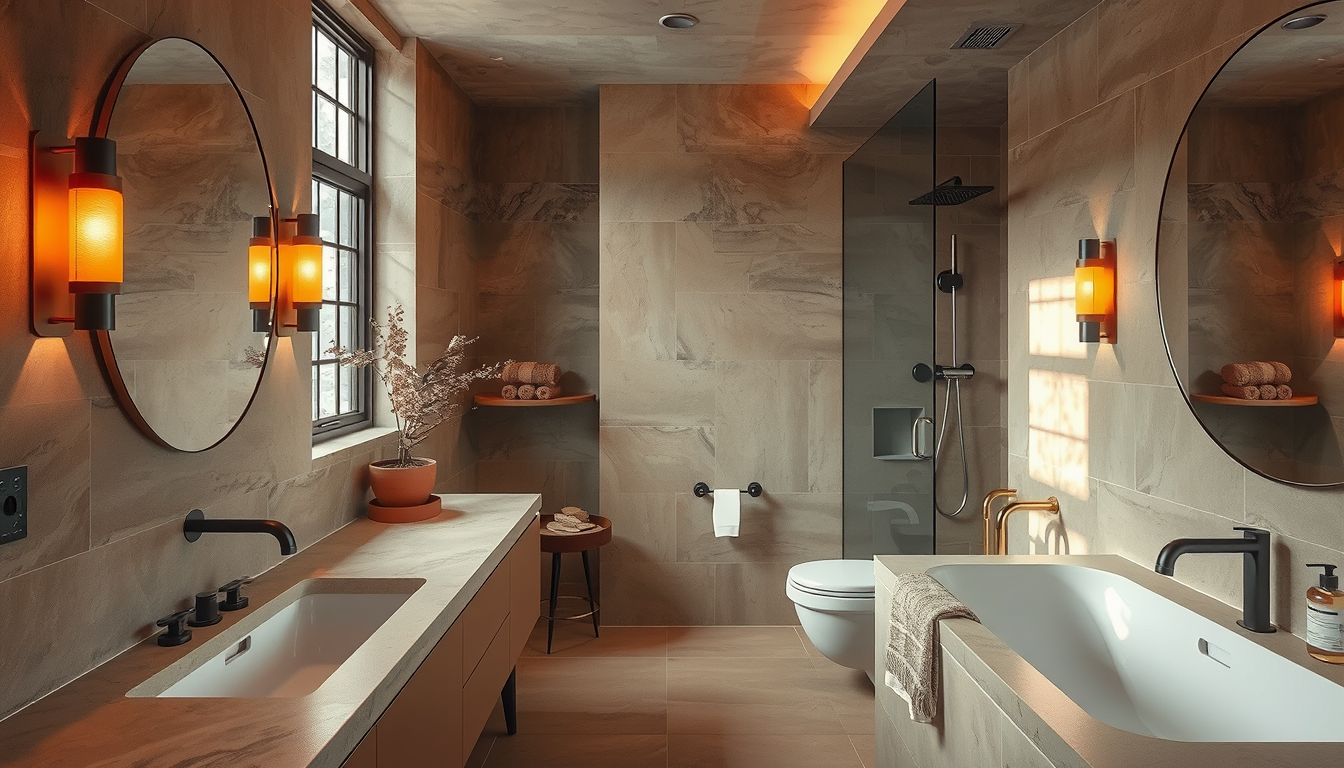
The top bathroom tile ideas toronto 2026 centre on three categories: zellige, fluted 3D-textured porcelain, and large-format slabs — with large-format porcelain delivering the best value at $18–$30 per square foot installed (Ciot Toronto, Stone Tile, Centura Tile Q1 2026 pricing). Toronto designers are increasingly rejecting the grey subway tile that dominated the last decade. Tile typically accounts for 15–25% of a full bathroom renovation budget, which runs $15,000–$45,000 in the GTA depending on scope (HomeStars Canada 2026).
What Toronto designers specify differs sharply from US trend roundups, because our condo dimensions, building code, and supplier ecosystem create different constraints entirely. This guide covers the trends local designers are pulling from Toronto showrooms right now — with real pricing, sourcing, and the condo-specific details that generic renovation advice leaves out.
What Bathroom Tile Trends Are Toronto Designers Specifying in 2026?
Three tile categories dominate Toronto designer specifications in 2026: zellige (handmade Moroccan clay tile with undulating surfaces), fluted or 3D-textured porcelain (vertical ribbed profiles that catch light in windowless bathrooms), and large-format porcelain slabs (1200×600 mm or larger, minimizing grout lines in small spaces).
The broader shift is maximalist. Checkerboard and geometric patterned floor tile is seeing a significant revival across Canadian design media (House & Home 2025–2026), while sculptural collections like Ward & Gray’s Vestigia line treat tile as a three-dimensional art surface, not just a waterproof finish (Domino 2026 tile roundup).
Why Is Fluted Tile So Popular in Toronto Condos?
For Toronto specifically, fluted tile performs well in north-facing condo bathrooms where natural light is limited. The vertical texture creates shadow play under vanity lighting, adding visual depth without requiring a larger footprint. We have seen this work particularly well in Liberty Village and CityPlace units with single north-facing windows.
How Much Does Bathroom Tile Cost in Toronto: Material, Labour, and Hidden Fees?
Upgrade the Details That Change Everything
Lighting, mirrors, and matte hardware can make a modest bathroom renovation feel far more custom.
Toronto Interior Designer may earn a commission if you shop through these links at no extra cost to you.
Tile costs vary dramatically by category. Here is what GTA contractors and suppliers are quoting in 2026:
| Tile Type | Material Cost/sq ft (CAD) | Installed Cost/sq ft (CAD) | Best For |
|---|---|---|---|
| Large-format porcelain slab | $8–$15 | $18–$30 | Small condos, minimal grout |
| Zellige (handmade) | $18–$35 | $32–$55 | Feature walls, powder rooms |
| Fluted/3D-textured porcelain | $12–$22 | $24–$40 | North-facing, low-light baths |
| Checkerboard porcelain | $6–$12 | $16–$25 | Floors, vintage character homes |
| Mosaic (marble or porcelain) | $15–$28 | $28–$45 | Shower floors, niches |
(Pricing compiled from Ciot Toronto, Stone Tile, and Centura Tile showroom quotes, Q1 2026)
What Hidden Costs Should You Budget For?
Ontario Building Code (Section 7) requires a waterproof membrane — such as Schluter DITRA or a liquid-applied system — behind all shower tile installations. This adds $4–$8 per square foot in material and labour (CHBA 2025–2026), a line item most US-focused articles omit entirely. For a typical 40–50 square foot Toronto condo bathroom, that is $200–$400 in waterproofing alone before a single tile is set.
What Extra Costs Do Condo Owners Face?
Many Toronto condo boards require contractor insurance certificates, restrict construction to weekdays 9 a.m.–5 p.m., and enforce wet-over-dry rules that can require engineering sign-off for relocated plumbing (City of Toronto building permit requirements). These requirements can add one to two weeks to your project timeline and $500–$1,500 in permit and administrative fees (BILD GTA Construction Cost Index).
Which Tiles Work Best in Small Toronto Condo Bathrooms?
Toronto condo bathrooms average 40–50 square feet (Urbanation 2025 GTA condo market data), roughly half the size of a suburban main bath. That constraint turns tile format selection from a purely aesthetic choice into a functional one.
Large-format tiles (600×600 mm or larger) reduce grout lines, making tight spaces feel more continuous. In a 5×8-foot condo bath, switching from 4×4-inch tile to 24×24-inch porcelain can cut visible grout lines by over 70%, creating the illusion of more floor area.
How Does Tile Size Look in Real Toronto Condos?
After visiting showrooms at Ciot on Caledonia Road and Stone Tile on Dupont, we measured sample layouts against standard CityPlace and Liberty Village condo bath dimensions — the visual difference is striking. A 24×24-inch slab in a 40-square-foot bathroom reads as a single continuous surface, while 4×4-inch mosaic fragments the same space into a busy grid.
Should You Use Mosaic Tile in a Small Bathroom?
Mosaic tile works in small doses — shower floors, niche accents, or a single feature strip — but covering all surfaces in small-format mosaic in a 40-square-foot bathroom creates visual noise. Toronto designers increasingly use mosaic strategically: a handmade zellige niche inside a large-format slab shower, for instance. This approach lets you introduce texture and personality without overwhelming a compact space.
Where to Source Bathroom Tile in Toronto: Best Local Showrooms
Toronto’s tile sourcing ecosystem is a genuine advantage over most North American markets. Three trade showrooms dominate local designer specifications:
Ciot Toronto (Caledonia Road) carries European collections from Mutina, Marazzi, and Fiandre — brands with limited or no US retail distribution. Their zellige and handmade collections are the broadest in the GTA. Stone Tile (Dupont Street) specializes in natural stone and artisan porcelain, with a designer library that lets you check out full-size samples. Centura Tile (multiple GTA locations) offers the widest mid-range selection with competitive installed pricing through their contractor network.
“The biggest mistake homeowners make is choosing tile from a 2-inch sample. At Ciot or Stone Tile, you can see full wall mock-ups under showroom lighting that mimics residential conditions — that is worth the trip before committing $3,000–$8,000 in material.”
What About Big-Box Alternatives?
Home Depot and Lowe’s carry serviceable porcelain at $3–$7 per square foot (CAD), and for rental bathrooms or secondary baths, that pricing makes sense. But the collections are primarily North American mass-production lines. If you want the European artisan tile driving 2026 trends — the undulating zellige, the sculptural fluted profiles — you will not find them at big-box. For budget-conscious renovation strategies, consider big-box for floor tile and allocate your budget to a showroom-sourced feature wall.
How to Pair Statement Tile With Toronto Vanity and Fixture Styles
Statement tile demands restraint elsewhere. Toronto Interior Designer projects consistently follow a “one hero, two supporting” rule: one bold tile surface (typically the shower wall or floor), a simple vanity, and understated fixtures.
For vanities, floating wall-mount styles remain dominant in GTA condos — they expose floor tile to maximize visual space and simplify cleaning in Toronto’s hard water environment. Toronto’s municipal water registers 124 mg/L hardness (City of Toronto water quality report), which deposits calcium buildup on fixtures and grout faster than soft-water cities. Choosing larger-format tile with minimal grout lines reduces maintenance.
How Should You Match Tile and Metal Finishes?
Fixture pairing follows the tile’s temperature: warm zellige pairs with brushed brass or unlacquered brass hardware, while cool fluted porcelain pairs with matte black or brushed nickel (House & Home 2025–2026). This mirrors what we see in local fireplace surround projects where material and metal finish coordination follows the same logic.
What About Toronto’s Humidity Swings?
Toronto’s climate cycles between winter dryness (15–20% indoor humidity) and summer humidity (60%+), stressing grout joints and adhesive bonds (Environment Canada climate data). Specifying a flexible, polymer-modified thinset — rather than standard mortar — prevents cracking from seasonal expansion and contraction. This is especially critical in older Junction semis and Annex homes where bathroom walls may not be perfectly plumb. Your installer should confirm they are using products rated for the temperature and humidity range specified in CSA A231.1.
The Verdict
For most Toronto condo bathrooms in 2026, large-format porcelain slabs with one zellige accent wall delivers the best balance of trend, function, and budget. If your bathroom exceeds 60 square feet and you want maximum impact, go full zellige — the handmade variation catches light beautifully and suits the proportions.
If you are renovating a rental or secondary bath, checkerboard porcelain at $6–$12 per square foot (Centura Tile Q1 2026) gives you the maximalist 2026 look at a fraction of the cost. Start with your room dimensions and your condo board’s rules — those two constraints will narrow the field faster than any trend report.
Your Toronto Bathroom Tile Renovation Checklist
- Measure your bathroom precisely — know your square footage before visiting showrooms
- Check your condo board’s renovation rules: wet-over-dry restrictions, construction hours, contractor insurance requirements
- Determine if you need a City of Toronto building permit (required for plumbing relocation or structural changes)
- Budget for Ontario Building Code waterproof membrane ($4–$8/sq ft installed)
- Visit at least two showrooms (Ciot, Stone Tile, or Centura) to see full-size samples under proper lighting
- Request installed pricing — material cost alone is misleading (labour adds 50–100% to material cost)
- Specify polymer-modified thinset for Toronto’s humidity cycling
- Factor in Toronto water hardness (124 mg/L) — minimize grout lines where possible
- Order 10–15% overage for cuts and future repairs
- Confirm your installer carries WSIB coverage and appropriate City of Toronto trade licensing
For more renovation planning, see our Toronto trends coverage and living spaces guides.
Frequently Asked Questions
How much does bathroom tile installation cost in Toronto?
Professional tile installation in Toronto costs $16–$55 per square foot fully installed, depending on tile type and complexity (HomeStars Canada 2026). A typical 40–50 square foot condo bathroom runs $1,500–$4,500 for tile material and installation combined, plus $200–$400 for the mandatory Ontario Building Code waterproof membrane (CHBA).
What is the most popular bathroom tile in Toronto for 2026?
Large-format porcelain slabs (24×24 inches or larger) are the most widely specified tile in Toronto condo bathrooms for 2026, followed by zellige for feature walls (Ciot Toronto and Stone Tile showroom data). The trend is away from subway tile and grey porcelain toward textured, dimensional surfaces.
Can I renovate my condo bathroom tile without board approval?
Most Toronto condo corporations require written approval for any bathroom renovation, even cosmetic tile replacement (Ontario Condo Act, Section 98). Construction is typically limited to weekdays 9 a.m.–5 p.m., and wet-over-dry rules may restrict plumbing relocation. Check your condo’s declaration and rules before hiring a contractor.
Is zellige tile worth the cost for a small Toronto bathroom?
Zellige tile costs $32–$55 per square foot installed — roughly double standard porcelain (Ciot Toronto Q1 2026). For a 40-square-foot condo bath, using zellige on a single accent wall (approximately 30 sq ft) adds $960–$1,650 versus standard porcelain — a meaningful but manageable upgrade.
Where can I see bathroom tile samples in person in Toronto?
Ciot Toronto (Caledonia Road), Stone Tile (Dupont Street), and Centura Tile (multiple GTA locations) are the three primary designer showrooms. All three allow walk-in visits, though Ciot and Stone Tile offer appointments for one-on-one consultations. Bring your bathroom dimensions and photos for the most productive visit.
Does Toronto’s hard water affect bathroom tile choices?
Yes — Toronto’s water hardness of 124 mg/L (City of Toronto water quality report) accelerates calcium and mineral deposits on tile and grout. Large-format tiles with fewer grout lines require less maintenance than mosaic patterns, and epoxy grout resists staining better than cement-based grout in hard-water environments, though it costs approximately $2–$4 more per square foot to install.
Sarah Chen | ARIDO Registered Interior Designer Sarah is a registered interior designer specializing in Toronto condo renovations, with 12 years of experience transforming GTA bathrooms from builder-basic to design-forward. She has completed over 80 residential projects across Liberty Village, the Junction, and midtown Toronto. (/author/sarah-chen/)
Sources
- HomeStars Canada, 2026 Renovation Cost Data
- Canadian Home Builders’ Association (CHBA), Renovation Cost Guidelines 2025–2026
- Ontario Building Code, Section 7 (Plumbing and Waterproofing Requirements)
- City of Toronto, Water Quality Annual Report (water hardness: 124 mg/L)
- City of Toronto, Building Permit Requirements for Residential Renovations
- Urbanation, GTA Condo Market Survey 2025
- Ciot Toronto, Stone Tile, and Centura Tile — Q1 2026 retail and installed pricing
- House & Home Magazine, 2025–2026 bathroom and tile trend coverage
- Ontario Condo Act, Section 98 (Owner Modifications)
- CSA A231.1, Ceramic Tile Installation Standards
- BILD (Building Industry and Land Development Association), GTA Construction Cost Index
- Environment Canada, Toronto Climate Normals (humidity data)
Keep Small Bathrooms Working Hard
Compact storage, simple shelving, and clean-lined accessories are the fastest way to add polish without crowding the room.
Toronto Interior Designer may earn a commission if you shop through these links at no extra cost to you.
Frequently Asked Questions
How much does bathroom tile installation cost in Toronto in 2026?
Professional bathroom tile installation in Toronto costs $16–$55 per square foot fully installed, depending on tile type. A typical 40–50 sq ft condo bathroom runs $1,500–$4,500 for material and labour combined, plus $200–$400 for the mandatory Ontario Building Code waterproof membrane.
What is the most popular bathroom tile trend in Toronto for 2026?
Large-format porcelain slabs (24×24 inches or larger) are the most specified tile in Toronto condo bathrooms for 2026, followed by zellige for accent walls. The trend is moving away from grey subway tile toward textured, dimensional surfaces like fluted 3D porcelain.
Does Toronto’s hard water affect which bathroom tiles you should choose?
Yes. Toronto’s water hardness of 124 mg/L accelerates mineral deposits on grout. Large-format tiles with fewer grout lines require less maintenance. Epoxy grout resists staining better than cement-based grout but costs $2–$4 more per square foot to install.
Toronto Interior Designer is editorially independent. Our recommendations are based on research and editorial judgment, not brand sponsorships.