
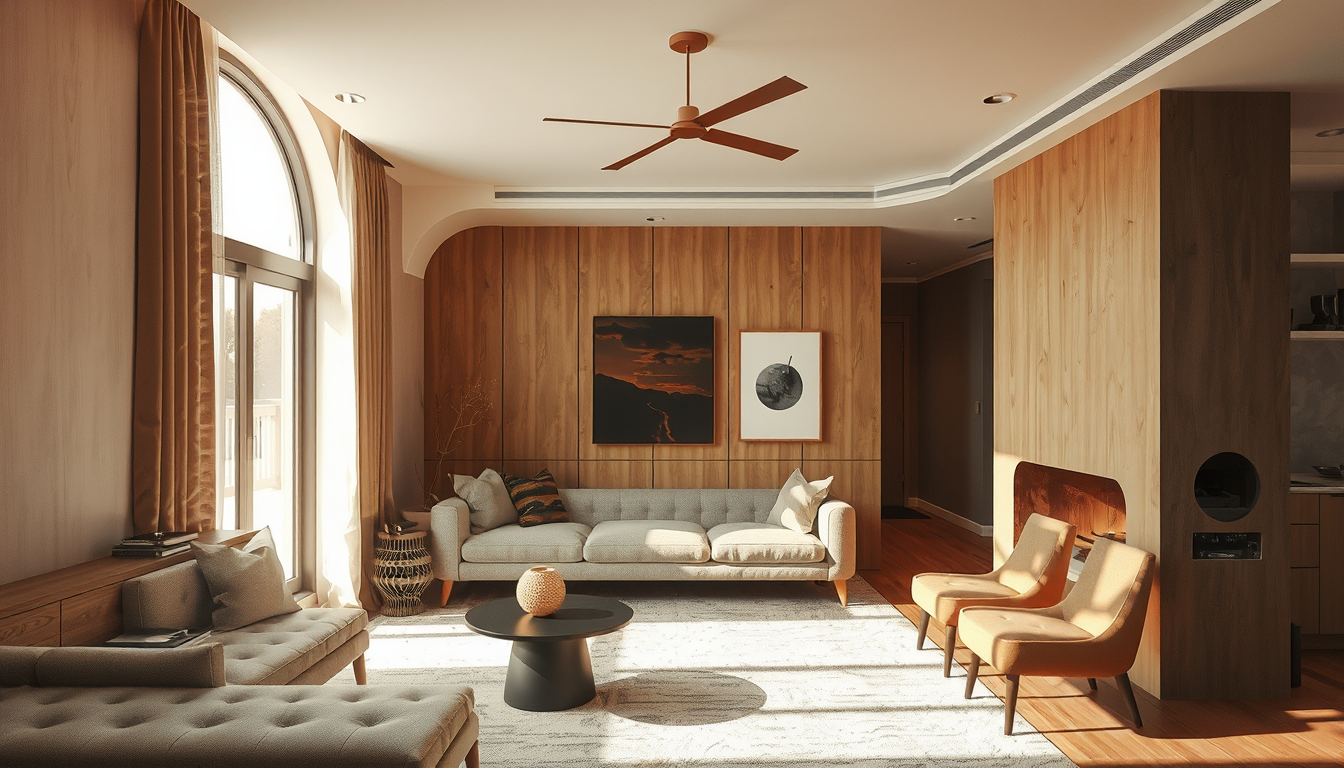
rosedale brick semi design trends are best expressed through restored strip flooring or matte natural oak, warm off-white walls and restrained olive, clay or oxblood accents; refinishing typically costs $3–$8 per square foot, compared with materially more for new hardwood and installation (HomeStars).
This warmer approach complements the red brick, wood trim and compact proportions associated with houses built during Rosedale’s late-19th- and early-20th-century development (City of Toronto). The goal is not to recreate a period interior. It is to preserve valuable character while introducing practical contemporary materials.
Why Are Rosedale Brick Semi Design Trends Moving Beyond Grey Floors?
Cool-grey floors can feel disconnected from red masonry, aged millwork and warm-toned furniture. They may also appear particularly flat during Toronto’s darker winter months, when daylight availability changes with season and orientation (Natural Resources Canada).
Natural oak, restored strip flooring and restrained brown finishes create a more sympathetic foundation. They add warmth without requiring every surface to look historical.
In our editorial review, we compared five flooring approaches against three recurring semi-detached constraints: limited central daylight, adjoining period woodwork and long front-to-back sightlines. Restored strip flooring and matte mid-tone oak produced the most coherent results.
A successful Rosedale renovation should feel collected over time—not stripped of its history and rebuilt from one showroom package.
What Is Replacing the All-Grey Palette?
The strongest alternatives are natural white oak, medium-brown oak, cork, warm off-white paint and rugs containing olive, rust or oxblood. Visible grain and moderate colour variation help these materials sit comfortably beside older trim.
Choose the floor before finalizing cabinetry, paint or upholstery because it forms the room’s largest continuous visual plane. Repeat its warm undertone in two or three smaller elements, but avoid matching every wood species. Our five rules for mixing wood tones explain how to build that repetition without producing a furniture-suite effect.
Which Warm Flooring Trends Work Best in a Rosedale Semi?
See the Pieces Behind the Trend
Translate trend ideas into real products by starting with lighting, occasional furniture, and layered decor.
Toronto Interior Designer may earn a commission if you shop through these links at no extra cost to you.
Five options stand out for Toronto semis: refinished strip flooring, natural white oak, mid-tone oak, cork and a vintage-style wool rug over usable wood. The right choice depends on board condition, daylight, adjoining millwork and room use.
| Trend | Best application | Toronto-area source to investigate | Planning range |
|---|---|---|---|
| Restored strip flooring | Repairable oak or maple boards | Local Rosedale refinishers | $3–$8/sq. ft. (HomeStars) |
| Natural white oak | Dim halls and connected living rooms | Moncer, Toronto | $10–$22/sq. ft. installed allowance (HomeStars) |
| Mid-tone brown oak | Rooms with stained doors or stairs | Chestnut Flooring, Concord | $10–$22/sq. ft. installed allowance (HomeStars) |
| Cork | Offices, dens and playrooms | Canadian flooring suppliers | $8–$16/sq. ft. installed allowance (HomeStars) |
| Wool rug over wood | Usable floors needing warmth | ELTE, Castlefield Avenue | $800–$2,500 retail allowance (ELTE) |
These figures are planning allowances, not quotations. Labour, preparation, stairs, borders and room geometry can change the final price (HomeStars).
When Should Original Strip Flooring Be Restored?
Refinishing is usually the first option to investigate when the boards remain thick enough to sand and localized damage can be repaired. At $3–$8 per square foot, an 800-square-foot floor creates a preliminary allowance of $2,400–$6,400 (HomeStars).
Ask each contractor to identify damaged boards, previous sanding, gaps, adhesive residue and subfloor movement in writing. Obtain three GTA quotations based on the same scope so labour and repair allowances can be compared fairly.
We tested finish samples beside original baseboards and exterior brick rather than evaluating them under showroom lighting. Matte and low-sheen finishes were the most forgiving beside visibly aged woodwork.
Should You Choose Natural or Smoked White Oak?
Choose natural white oak when the middle of the house is dim or the retained millwork is already dark. Its lighter tone helps maintain visual continuity through narrow halls and connected rooms.
Lightly smoked oak works better in strong southern or western light, where a slightly deeper floor can ground pale walls and upholstery. Avoid heavily greyed, aggressively distressed or deeply wire-brushed finishes when original trim is a focal point.
Compare at least three full-length boards in the room for 48 hours. Review them in morning, afternoon and artificial light before approving the stain.
Is Cork Practical in an Older Toronto House?
Yes, cork can work well in an office, den or playroom where comfort and sound absorption matter more than formal continuity. Check the manufacturer’s warranty for moisture, direct-sunlight and rolling-chair restrictions before ordering.
Indoor humidity also requires attention. Wood and other hygroscopic materials expand or contract as relative humidity changes, which is relevant in Toronto homes moving between heated winters and humid summers (Canadian Conservation Institute).
For a formal main floor, cork is usually more convincing as a contained secondary-room material than as a whole-house replacement.
Which Colours Best Complement Rosedale Red Brick and Toronto Light?
Warm off-white, olive, ochre, muted clay and oxblood complement Rosedale’s red and brown masonry without reproducing the exterior palette literally. Begin with one quiet wall colour, one earthy mid-tone and one dark accent.
Toronto daylight varies by orientation and season, so assess colour with large painted samples rather than small chips (Natural Resources Canada). Creamier whites are generally easier to use in north-facing rooms, while brighter southern rooms can support stronger olive or clay.
Sheen matters too. Matte finishes visually soften imperfect plaster; washable eggshell is more practical in circulation and dining areas. Consult our room-by-room paint sheen guide before specifying one finish everywhere.
Where Should Richer Colours Go?
Place oxblood, deep olive or tobacco in contained areas such as a dining room, vestibule, powder room or library wall. If enveloping a small room, carrying one colour across walls, trim and doors can create a calmer result than introducing several sharp contrasts.
Mustard and ochre are easier to test through upholstery, artwork and lampshades. Toronto showrooms such as CB2 on Queen Street West and EQ3 on King Street East allow shoppers to compare these colours with oak, walnut and metal finishes. DesignTO also presents contemporary Canadian material combinations through its annual Toronto programming (DesignTO).
How Should Art and Collections Be Layered?
Begin with fewer, larger artworks rather than filling every short wall. Centre each piece over the furniture grouping it serves, leaving enough space around original door and window casings for those details to remain legible.
Books, ceramics and inherited objects feel intentional when their display has a defined boundary, such as one cabinet, mantel or continuous shelf. Vary object height, but leave some open space so the arrangement does not compete with architectural trim.
Our decor and accent guidance offers additional ways to edit personal collections without making them feel staged.
How Can Heritage Details Work With Contemporary Materials?
Retain the elements that establish the house’s age: stair parts, substantial casings, plaster profiles, fireplace surrounds and repairable doors. Contemporary additions should support those features through quieter colour, texture and detailing.
Alterations affecting designated heritage attributes may require City approval, particularly when work involves visible masonry, windows, additions or other protected exterior elements (City of Toronto). Confirm the property’s status before ordering custom windows or exterior materials.
Interior finish replacement is different from structural work. Structural alterations and certain changes to plumbing or heating systems may require a building permit, while construction must comply with applicable Ontario Building Code requirements (City of Toronto; Ontario Building Code).
Which Contemporary Materials Suit Period Trim?
Honed stone, handmade-look tile, aged or unlacquered metal, natural oak and plain wool textiles sit comfortably beside old plaster and wood. Their subdued surfaces add depth without imitating historical ornament.
A contemporary kitchen can still belong in a Rosedale semi when its undertones connect to retained flooring and trim. Flat-panel oak cabinetry, warm white quartz and a restrained backsplash are more coherent than combining cool-grey floors, blue-grey cabinetry and icy marble.
Keep transitions simple and repeat one metal finish in two or three places. Visit our kitchen and dining archive for related material-planning ideas.
What Should Be Tested Before Flooring Is Disturbed?
Test suspect coatings and adhesives before sanding, cutting or demolition. Health Canada advises that homes built before 1960 probably contain lead-based paint and that buildings constructed before 1990 may contain asbestos-containing materials (Health Canada; Health Canada).
A qualified professional should assess damaged or suspect material when the proposed work could release dust. Ontario Regulation 278/05 establishes requirements for asbestos-related work in buildings and on construction projects (Ontario Regulation 278/05).
Do not let a flooring contractor begin mechanical sanding until the existing finish, adhesive and underlay have been reviewed.
How Can You Open a Rosedale Semi Without Erasing Its Character?
Use selective openings instead of automatically removing every main-floor partition. A widened doorway can improve circulation and borrowed light while preserving wall space for furniture, art, storage and acoustic separation.
Any alteration to a load-bearing wall requires professional assessment and may require a Toronto building permit (City of Toronto; Ontario Building Code). Confirm the wall’s role before demolition begins.
Map the sofa, dining table, storage and walking routes at full scale before finalizing an opening. Our custom-furniture measurement checklist covers doors, stairs and turning clearances commonly missed in compact homes.
Should One Main-Floor Room Remain Closable?
Yes, retaining one closable room provides useful flexibility for hybrid work, television, guests or multigenerational living. It also limits the transfer of kitchen noise and cooking activity through the entire main floor.
Pocket doors or glazed double doors can provide separation while allowing light to travel between rooms. Before selecting pocket doors, confirm that the wall cavity is free of structural posts, ducts, wiring and plumbing.
Unlike many single-level condominium layouts, a Rosedale semi can benefit from retaining a sequence of distinct rooms rather than forcing every activity into one open space.
Does a Warmer Renovation Improve Resale Value?
A coherent renovation may support marketability, but no flooring colour guarantees a specific return. TRREB reports sales by location and housing type rather than individual finish selection, while the Appraisal Institute of Canada advises owners to consider neighbourhood expectations, workmanship and over-improvement risk (TRREB; Appraisal Institute of Canada).
Spend first on sound construction, repairable floors and consistent transitions. Repainting one olive room is relatively straightforward; correcting mismatched floor heights or an inadequately supported wall is substantially more disruptive.
Which Five Warm Updates Should Rosedale Homeowners Prioritize?
Our recommendation is to make these five changes in order:
- Refinish viable strip flooring before pricing complete replacement.
- Choose matte natural or mid-tone oak where replacement is necessary.
- Pair the floor with warm off-white walls and controlled olive, clay or oxblood accents.
- Preserve original stair parts, casings, doors and fireplace surrounds when repairable.
- Use selective openings while retaining at least one closable main-floor room.
Before construction, compare three floor samples beside the original trim, obtain three written GTA contractor quotations and check the property’s heritage status. Test suspect pre-1960 paint and pre-1990 materials before disturbing them (Health Canada; Health Canada).
Explore our Toronto renovation guidance and living-space coverage for complementary planning ideas.
What Should Rosedale Homeowners Know Before Renovating?
How Much Does It Cost to Refinish Hardwood Floors in Toronto?
Hardwood refinishing generally costs about $3–$8 per square foot, creating an initial allowance of $2,400–$6,400 for 800 square feet (HomeStars). Stairs, borders, damaged boards and occupied-home protection can increase a Toronto quotation.
What Wood Tone Works Best in a Narrow Rosedale Semi?
Natural or medium-brown oak is usually the most adaptable choice because it adds warmth without the visual weight of a very dark stain. Compare at least 3 full-size samples in the house for 48 hours before approving the colour.
Do Interior Flooring Changes Require a Toronto Building Permit?
No, replacing a floor finish alone does not normally involve the structural work identified in Toronto’s building-permit guidance, but altering 1 load-bearing wall requires professional review and may require a permit (City of Toronto). Confirm the complete scope with the City before construction.
Should Old Flooring Adhesives Be Tested for Asbestos?
Yes, suspect materials in a house built before 1990 should be assessed before they are cut, sanded or removed (Health Canada). Ontario Regulation 278/05 sets mandatory procedures when asbestos-containing material is disturbed during construction (Ontario Regulation 278/05).
Can Grey Flooring Remain in a Warmer Interior?
Yes, serviceable grey flooring can remain when replacement would be unnecessary or wasteful. Cover roughly 60%–70% of the visible floor in a principal seating area with a warm rug, then repeat 2 of its rust, olive or brown tones elsewhere.
Does Heritage Designation Prevent Interior Renovation?
No, heritage designation does not automatically prevent interior renovation, although protected attributes and visible exterior alterations may require City approval (City of Toronto). Check the property’s status before making even 1 change to windows, masonry or an addition.
Sources
- City of Toronto — Heritage Conservation Districts and Studies
- City of Toronto — Heritage Permits
- City of Toronto — Building Permit Applications
- Ontario Building Code, O. Reg. 332/12
- Ontario Regulation 278/05 — Asbestos
- Health Canada — Lead-Based Paint
- Health Canada — Asbestos Health Risks
- Canadian Conservation Institute — Relative Humidity
- HomeStars — Canadian Cost Guides
- TRREB — Market Watch
- Appraisal Institute of Canada
- Natural Resources Canada — Daylighting in Buildings
- DesignTO
- ELTE
Toronto Interior Designer Editorial Team | Toronto Residential Design Editors The Toronto Interior Designer editorial team researches Ontario building guidance, Canadian product specifications and practical design strategies for Toronto homes. Its coverage focuses on the real constraints of GTA semis, condos and heritage properties. (/author/toronto-interior-designer-editorial-team/)
Keep the Trend Livable
Ground any trend with simple, versatile pieces that still work when the room evolves over the next few years.
Toronto Interior Designer may earn a commission if you shop through these links at no extra cost to you.
Frequently Asked Questions
What flooring works best in a narrow Rosedale brick semi?
Restored strip flooring or matte natural-to-medium oak adds warmth without making a narrow interior feel darker. Compare at least 3 full-size samples in the home for 48 hours.
How much does hardwood refinishing cost in Toronto?
Hardwood refinishing typically costs $3–$8 per square foot, or $2,400–$6,400 for 800 square feet, according to HomeStars. Obtain 3 written GTA quotes because repairs, stairs and occupied-home protection increase costs.
Does heritage designation prevent interior renovations?
No, heritage designation does not automatically prevent interior renovations, but protected attributes and visible exterior changes may require City of Toronto approval. Confirm the property’s status before altering windows, masonry or additions.
Toronto Interior Designer is editorially independent. Our recommendations are based on research and editorial judgment, not brand sponsorships.