
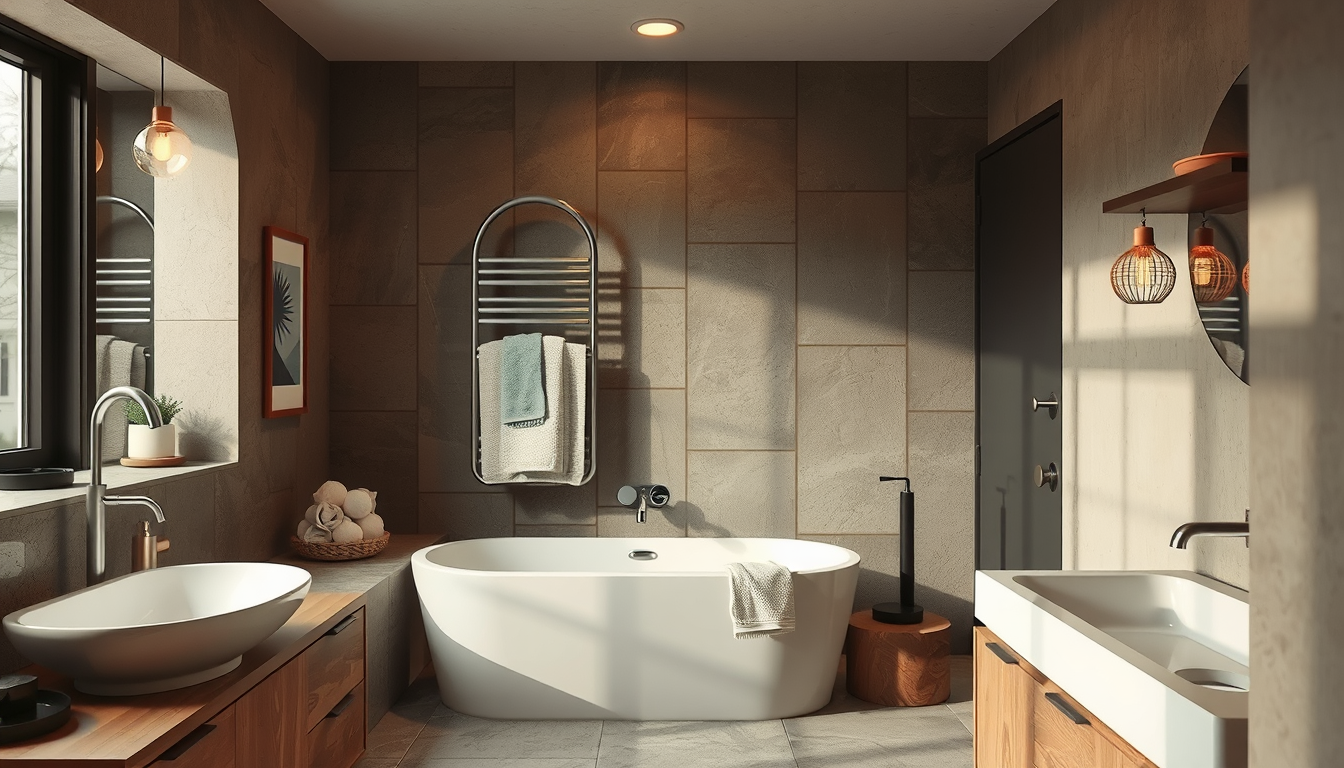
A heated towel rail bathroom works best with a 100–150-watt hardwired electric ladder rail and programmable timer. This setup provides year-round towel warming without relying on a building’s heating schedule, while a 150-watt model running eight hours consumes 1.2 kWh before timer or thermostat savings (WarmlyYours; Amba Products; ICO Bath).
Last updated: April 1, 2026 Meta description: Choose a heated towel rail bathroom fixture with Toronto pricing, electrical requirements, condo advice and operating costs.
Toronto Interior Designer recommends hardwired electric rails for most renovations because they suit both houses and compact condominiums and operate independently of a boiler (WarmlyYours; Amba Products; ICO Bath). Hydronic models are better reserved for houses already undergoing compatible boiler or hot-water heating work.
This article contains no affiliate links. Prices are 2026 planning allowances in Canadian dollars before HST; obtain at least three written quotations because labour, electrical and wall-repair costs vary by site conditions (HomeStars Canada 2026).
Why Does a Heated Towel Rail Bathroom Make Sense in Toronto?
A heated rail provides targeted towel warming without replacing the bathroom’s primary heating or ventilation systems. It can help moisture leave towels more quickly, but it cannot replace the mechanical ventilation required under applicable Ontario Building Code provisions (Ontario Building Code).
The benefit is especially noticeable during Toronto’s cold winters and seasonal humidity changes (Environment and Climate Change Canada). In a CityPlace condominium, an electric rail can operate independently of the building’s seasonal HVAC schedule; in a Junction semi-detached house with compatible hydronic heating, either electric or hydronic equipment may be possible.
A heated rail improves the towel; a properly sized exhaust fan protects the room.
What practical benefits should you expect?
A timer-controlled rail can warm towels before morning use and continue operating afterward to assist drying. Actual drying performance depends on wattage, towel thickness, bar spacing, room humidity and permitted towel coverage (WarmlyYours; Amba Products; ICO Bath).
Toronto tap water averages approximately 124 mg/L of hardness as calcium carbonate and is classified as moderately hard (City of Toronto). Brushed finishes generally make mineral spotting less conspicuous than mirror-polished surfaces, although all splash-prone rails should be cleaned according to the manufacturer’s instructions.
For broader project planning, see our renovation tips and Toronto bathroom design guides.
What Should Toronto Homeowners Budget?
Upgrade the Details That Change Everything
Lighting, mirrors, and matte hardware can make a modest bathroom renovation feel far more custom.
Toronto Interior Designer may earn a commission if you shop through these links at no extra cost to you.
Toronto homeowners should budget approximately $900–$2,100 for a typical hardwired electric rail, including a standard fixture and installation allowance (HomeStars Canada 2026; Canadian manufacturer pricing). New circuits, tile repairs and premium fixtures can push the project above $4,000 (HomeStars Canada 2026).
| Upgrade | Toronto Cost Range (CAD) | Typical On-Site Time | Permit or Approval? |
|---|---|---|---|
| Plug-in electric rail and mounting | $350–$950 | 1–3 hours | Usually no ESA notification when using an existing suitable receptacle |
| Hardwired electric rail | $900–$2,100 | 3–8 hours | ESA notification generally applies to new wiring |
| Designer or large-format electric rail | $1,700–$4,000 | 4–8 hours | ESA notification generally applies |
| Hydronic rail and connection | $2,800–$6,500 | 1–2 days | Building or condo review may apply |
| Wall timer or compatible control | $300–$700 | 1–3 hours | ESA notification may apply when wiring changes |
| Tile opening, backing and repair | $600–$1,800 | 1–3 days | Condo approval may apply |
| Dedicated circuit, if required | $700–$1,500 | 4–8 hours | ESA notification required |
Cost basis: HomeStars Canada cost guides, ESA requirements and Canadian-market listings from WarmlyYours, Amba Products and ICO Bath, accessed March 2026.
Which costs are easiest to overlook?
Wall reinforcement, tile replacement, painting and electrical-panel access are commonly separate from the fixture price (HomeStars Canada 2026). Condo projects may also involve contractor insurance documents, elevator reservations or refundable damage deposits under building-specific rules (Condominium Authority of Ontario).
Ask each contractor to identify the fixture, control, wiring, ESA notification, wall repair and HST separately. Itemized quotations make it easier to compare scopes and avoid treating a fixture-only price as a complete installed cost.
Is an Electric or Hydronic Heated Towel Rail Bathroom Better?
An electric rail is the better fit for most Toronto bathrooms because it can operate throughout the year without depending on a boiler or central heating loop (WarmlyYours; Amba Products; ICO Bath). Models may use a dry element or a sealed, factory-filled heating medium, depending on the manufacturer (WarmlyYours; Amba Products; ICO Bath).
Hydronic rails connect to a compatible space-heating system. Their performance depends on system design, water temperature and seasonal operation, so an Ontario plumber or heating contractor should verify compatibility before purchase (Ontario Building Code).
| System | Best Application | Main Limitation |
|---|---|---|
| Plug-in electric | Rental or light renovation with a suitable receptacle | Visible cord and restricted placement |
| Hardwired electric | Condo or house renovation requiring a clean finish | Licensed electrical work is normally required |
| Hydronic | House with compatible boiler work already planned | Invasive installation and potentially seasonal operation |
Why are electric rails usually easier in condos?
Condo owners cannot assume visible pipes or concealed building services belong solely to the unit. Declarations, bylaws and rules may restrict changes affecting wiring, plumbing and common elements (Condominium Authority of Ontario).
A hardwired electric rail usually involves fewer building-system complications than a hydronic connection, although electrical approval and an ESA notification may still apply (Electrical Safety Authority). Coordinate accessible clearances with grab bars and transfer areas using our shower transfer bench safety guide.
How Do You Choose Heated Towel Rail Size, Finish and Wattage?
Start with usable wall area, then compare bar spacing, wattage, controls and permitted mounting orientation. Canadian-market electric rails commonly range from approximately 60 to 250 watts, with formats extending from compact four-bar models to full-height ladders (WarmlyYours; Amba Products; ICO Bath).
A higher wattage does not automatically provide better towel coverage. Towels need adequate contact with warm bars and should not be folded or overlapped in ways prohibited by the installation instructions (WarmlyYours; Amba Products; ICO Bath).
What did our specification review find?
We compared Canadian installation manuals, dimensions and control options from WarmlyYours, Amba Products and ICO Bath. In our specification review, wider ladder-style rails were easier to match with standard bath towels than narrow sculptural models, while programmable controls offered more practical scheduling than basic on-off switches.
Before ordering, we recommend outlining the full fixture and hanging towel with painter’s tape. Check the door swing, shower glass, vanity drawers and walking path at full scale; this is especially useful in compact CityPlace and Liberty Village condominiums.
Which finish works with an existing bathroom?
Choose the rail to complement the room’s dominant permanent finish rather than matching every accessory. Brushed stainless steel and satin nickel tend to make water marks less conspicuous, while matte black creates stronger contrast but can reveal pale mineral residue more readily.
Toronto’s water averages approximately 124 mg/L of hardness as calcium carbonate, making regular surface care worthwhile in splash-prone locations (City of Toronto). If the room includes a stone vanity, compare finish samples beside the slab under installed lighting; our Toronto natural-stone countertop guide explains why lighting and samples matter.
Where Can a Heated Towel Rail Be Installed Safely?
Install the rail where towels can hang without obstructing doors, circulation or accessibility features. Electrical work must comply with the Ontario Electrical Safety Code, the product’s certified instructions and applicable ground-fault protection requirements (Electrical Safety Authority).
There is no single shower-clearance rule suitable for every towel rail because certification, product ratings, circuit design and installation conditions vary (Electrical Safety Authority). Have an ECRA/ESA-licensed electrical contractor approve the exact location before tile or drywall is closed.
What certifications and approvals are required?
Select a product carrying a Canadian-recognized certification mark, such as CSA, cUL or another mark accepted by the Electrical Safety Authority. Electrical products installed or sold in Ontario must be approved for Canadian use (Electrical Safety Authority).
New hardwired connections should be completed under the appropriate ESA notification by an ECRA/ESA-licensed electrical contractor (Electrical Safety Authority). Simply mounting a fixture does not normally trigger a City of Toronto building permit, but associated structural, plumbing or major renovation work may require one (City of Toronto).
What changes in a Toronto condo?
Obtain written property-management approval before drilling, opening walls or altering wiring. Condo declarations and rules may restrict changes to units and common elements, while individual buildings can require drawings, insurance certificates, deposits and approved construction hours (Condominium Authority of Ontario).
Wet-over-dry restrictions may limit plumbing changes above another unit’s living or sleeping space, depending on the condominium’s governing documents (Condominium Authority of Ontario). Plan backing and wiring before tile installation so mounting points follow the manufacturer’s instructions. Similar advance blocking is useful for wall-mounted equipment in a Toronto pet-grooming nook.
How Much Does a Heated Towel Rail Bathroom Cost to Operate?
A 150-watt rail operating for eight hours consumes 1.2 kWh: 0.15 kW multiplied by eight hours. At an illustrative electricity price of $0.158 per kWh, the energy charge is approximately $0.19 per day or $5.69 over 30 days (Ontario Energy Board).
Electricity rates change periodically, and delivery, regulatory charges and tax also affect the final bill (Ontario Energy Board). These calculations therefore illustrate energy consumption rather than guarantee household savings.
How much can a timer change consumption?
Reducing a 150-watt rail’s scheduled operation from eight hours to four hours lowers calculated consumption from 1.2 to 0.6 kWh per day. At $0.158 per kWh, that is approximately $2.84 in energy charges over 30 days instead of $5.69 (Ontario Energy Board).
Actual consumption may differ because controls, thermostat cycling and electricity plans vary. Program the rail to warm before use and remain on only as long as needed for practical drying, subject to the manufacturer’s operating instructions. Compare controls and warranties in our Canadian buyer guides.
What Is Our Recommendation for Toronto Bathrooms?
For most Toronto homes, choose a 100–150-watt hardwired electric ladder rail with a programmable wall timer and a Canadian-recognized certification mark. This range is a practical starting point for one or two towels, subject to the selected manufacturer’s coverage and operating instructions (WarmlyYours; Amba Products; ICO Bath).
Choose a plug-in model for a reversible upgrade when a suitable existing receptacle and approved installation location are available (Electrical Safety Authority). Consider hydronic equipment only when a compatible boiler renovation is already planned and a qualified heating contractor has reviewed the system (Ontario Building Code).
What Should Be on Your Heated Towel Rail Bathroom Checklist?
- Measure the wall, door swing, shower glass and hanging-towel clearance.
- Compare certified Canadian-market models between approximately 60 and 250 watts (WarmlyYours; Amba Products; ICO Bath).
- Confirm a CSA, cUL or other ESA-recognized certification mark (Electrical Safety Authority).
- Request written condo approval before opening walls or altering wiring (Condominium Authority of Ontario).
- Check wet-over-dry rules, construction hours and elevator procedures.
- Hire an ECRA/ESA-licensed electrical contractor for hardwired work (Electrical Safety Authority).
- Confirm whether an ESA notification or City of Toronto permit applies.
- Coordinate backing, wiring and controls before tile installation.
- Retain code-compliant mechanical ventilation for moisture control (Ontario Building Code).
- Obtain three itemized Toronto contractor quotations before ordering.
Sources
- City of Toronto — Tap Water in Toronto
- City of Toronto — Building Permit Guide
- Electrical Safety Authority — Licensed Electrical Contractors
- Electrical Safety Authority — Recognized Certification Marks
- Ontario Energy Board — Electricity Rates
- Ontario Building Code
- Condominium Authority of Ontario — Condo Living
- HomeStars Canada — Cost Guides
- Environment and Climate Change Canada — Canadian Climate Normals for Toronto
- WarmlyYours, Amba Products and ICO Bath — Canadian product specifications and installation manuals
What Are the Most Common Heated Towel Rail Bathroom Questions?
How much electricity does a heated towel rail use?
A 150-watt heated towel rail uses 1.2 kWh when operated for eight hours. At an illustrative rate of $0.158 per kWh, that equals approximately $0.19 in daily energy charges before delivery, regulatory charges and tax (Ontario Energy Board).
Does a heated towel rail replace a bathroom exhaust fan?
No, a heated towel rail does not replace code-compliant mechanical ventilation. Even if a 150-watt rail helps towels dry, the bathroom must still meet applicable Ontario Building Code ventilation requirements (Ontario Building Code).
Does an electric towel rail need GFCI protection?
It depends on the exact location, circuit arrangement, equipment and current Ontario Electrical Safety Code requirements. Before installing even a 100-watt model, have an ECRA/ESA-licensed electrical contractor assess the placement and required protection (Electrical Safety Authority).
Can a heated towel rail be installed in a Toronto condo?
Yes, a heated towel rail can be installed in many Toronto condos, but written approval may be required before wiring changes or wall openings begin. Even a 150-watt hardwired rail should be reviewed by a licensed electrical contractor, and the condo may impose construction hours, insurance requirements or alteration rules (Condominium Authority of Ontario; Electrical Safety Authority).
How much does professional installation cost in Toronto?
Budget approximately $900–$2,100 for a standard hardwired electric rail, including a typical fixture and installation allowance. Designer models, a new circuit or tile repairs can increase the total to $4,000 or more (HomeStars Canada 2026; Canadian manufacturer pricing).
What wattage works for a small Toronto bathroom?
A 100–150-watt rail is a practical starting range for warming and drying one or two towels. Confirm the manufacturer’s towel-coverage instructions because wattage does not replace a bathroom heat-load calculation or determine performance by itself (WarmlyYours; Amba Products; ICO Bath).
Toronto Interior Designer Editorial Team | Toronto-Focused Interiors Research Team
The Toronto Interior Designer Editorial Team researches fixtures, renovation requirements and practical design choices for GTA houses and condominiums. Its coverage emphasizes Ontario safety rules, Toronto building conditions and transparent Canadian pricing.
(/author/editorial-team/)
Keep Small Bathrooms Working Hard
Compact storage, simple shelving, and clean-lined accessories are the fastest way to add polish without crowding the room.
Toronto Interior Designer may earn a commission if you shop through these links at no extra cost to you.
Frequently Asked Questions
How much electricity does a heated towel rail use?
A 150-watt heated towel rail uses 1.2 kWh over eight hours. At $0.158 per kWh, the energy charge is approximately $0.19 per day before other bill components.
How much does a heated towel rail cost to install in Toronto?
Budget approximately $900–$2,100 for a standard hardwired electric model. Designer fixtures, new circuits, or tile repairs can increase the total to $4,000 or more.
Can you install a heated towel rail in a Toronto condo?
Yes, but obtain written condo approval before opening walls or changing wiring. A hardwired model must be installed by an ECRA/ESA-licensed electrical contractor, and building-specific renovation rules may apply.
Toronto Interior Designer is editorially independent. Our recommendations are based on research and editorial judgment, not brand sponsorships.