
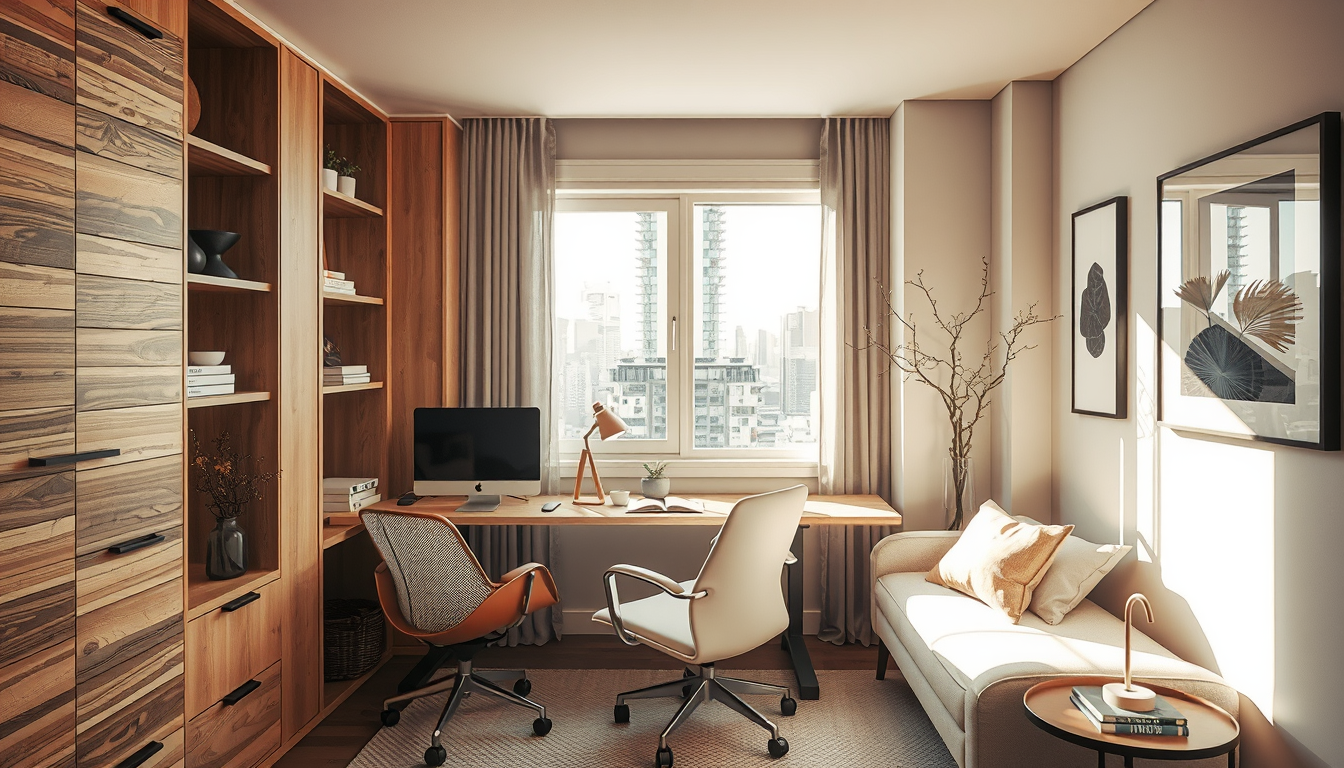
If you work from home in Toronto, you already know the feeling: it is 4 p.m., your screen glares against a suddenly dark window, and your energy craters — which is exactly why home office lighting ideas canada winter searches spike every November. By mid-December, the city gets barely nine hours of daylight, with sunset arriving around 4:43 p.m. Most remote workers lose usable natural light right in the middle of their afternoon. The fix is not just “buy a brighter lamp.” It is a layered lighting strategy designed around northern-latitude realities — one that protects your productivity, supports your mood, and still looks good in a 120-square-foot spare bedroom. Here is the system Toronto Interior Designer recommends.
Why Toronto’s Winter Light Fails Home Offices by 3 p.m.
Toronto sits at roughly 43.7°N latitude. On the winter solstice, the city receives approximately 8 hours and 56 minutes of daylight, and the sun angle stays low enough that north-facing rooms can drop below usable brightness by 3 p.m. . That is not just inconvenient — it is a health issue. The Canadian Mental Health Association estimates that 2–3% of Canadians experience severe Seasonal Affective Disorder, while up to 15% deal with milder winter blues .
For remote workers, the problem compounds. The Canadian Centre for Occupational Health and Safety recommends 300–500 lux at the desk surface for computer work . Most Toronto rooms with standard ceiling fixtures deliver 150–200 lux on a clear day. By late afternoon in December, you are working in what amounts to dim restaurant lighting — fine for a date, terrible for a spreadsheet.
Statistics Canada reported that over 40% of Canadian workers who could work remotely did so at least partially as of 2024 . This is not a niche problem. It is a mass-market design challenge, and the right lighting plan solves it for under $300.
The 3-Layer Home Office Lighting System for Canadian Winters
Shop Compact Work-From-Home Staples
Desks, task lamps, and shelving do more for a condo office than oversized furniture that eats the room.
Toronto Interior Designer may earn a commission if you shop through these links at no extra cost to you.
Professional lighting designers use a three-layer approach: ambient, task, and accent. In a Canadian winter home office, each layer has a specific job tied to the season.
| Layer | Purpose | Recommended Colour Temp | Budget Range (CAD) | Best Product Type |
|---|---|---|---|---|
| Ambient | Replaces lost daylight, fills the room evenly | 4000–5000K (neutral to cool white) | $40–$120 | LED ceiling panel or floor uplighter |
| Task | Delivers 300–500 lux directly on your work surface | 5000–6500K (daylight range) | $60–$150 | Adjustable desk lamp with dimmer |
| Accent | Adds warmth and visual interest after sunset | 2700–3000K (warm white) | $25–$80 | LED strip behind monitor, shelf sconce |
The key insight: do not try to do everything with one light source. A single overhead fixture washing the room in 5000K light will feel clinical by 7 p.m. Instead, keep your task light cool and bright during working hours, then transition to warmer ambient and accent layers as you wind down. If you are setting up a home office in a small condo, this layered approach works even in a closet-sized nook because each fixture is compact and purpose-built.
“The biggest mistake I see in Toronto home offices is a single warm-toned ceiling light doing triple duty. By 4 p.m. in January, it is like working inside a candle. Layer cool task lighting on top — your eyes and your deadlines will thank you.”
Best Task Lamps and Desk Lights for Dark Canadian Afternoons
Not all desk lamps are created equal, especially when you need them to compensate for four months of early darkness. Here is what to prioritize:
- Colour temperature range of 5000–6500K. Research in workplace lighting shows that daylight-range colour temperatures support alertness and cognitive performance compared to warm 2700K bulbs . Look for lamps with adjustable Kelvin settings so you can shift warmer in the evening.
- Minimum 500 lux at desk height. Check the lux rating, not just lumens. A 1,000-lumen lamp aimed at the ceiling is useless for task work. You need directed light hitting your desk surface at a 45-degree angle or less.
- CRI of 90 or higher. Colour Rendering Index determines how accurately you see colours under artificial light. If you do any design, photography, or video calls, a high CRI lamp prevents you from looking washed out on camera.
- Adjustable arm and head. Fixed-position lamps create glare on screens. An articulating arm lets you angle light onto paper or a secondary monitor without reflecting off your primary display.
- Dual-purpose SAD capability. Full-spectrum LED desk lamps rated at 10,000 lux — the clinical threshold for SAD light therapy — now start under $80 CAD from brands like Verilux and Carex. Position one at roughly 40 cm from your face during morning hours and you get therapy and task lighting from one fixture.
For those also rethinking their bedroom lighting for winter warmth, the same Kelvin-shifting principle applies — cool and bright by day, warm and dim by evening.
How to Integrate SAD Therapy Lighting Into Your Home Office Décor
The clinical look of traditional SAD lamps — boxy white panels on plastic stands — has kept many design-conscious homeowners from using them. Current-generation therapy lights now come in slim desk lamp profiles, minimalist wall-mount panels, and pendant-style fixtures that blend into a modern workspace. Here is how to integrate them without sacrificing aesthetics:
- Behind-monitor panel mount. A slim 10,000-lux panel mounted behind your monitor sits in your peripheral vision at the correct angle without taking up desk space. It reads as a backlight accent, not a medical device.
- Window-sill light box. Place a therapy light on the sill of a north-facing window. It supplements the weak natural light and tricks your eye into reading the window zone as brighter than it actually is.
- Shelf-integrated strips. LED strips rated at 5000K+ tucked under floating shelves above your desk deliver diffused, high-Kelvin light downward without any visible fixture. Clean lines, no clinical vibe.
The goal: get 10,000 lux near your face for 20–30 minutes in the morning, then let your layered system carry you through the afternoon fade.
Smart Lighting Schedules That Mimic Natural Daylight All Winter
If your fixtures are smart-enabled — and most LED bulbs now work with basic smart plugs — you can automate your lighting to follow a circadian-friendly schedule. Here is a starting template for Toronto’s deep winter:
- 7:00–8:00 a.m. Gradually ramp ambient lights to 5000K and 80% brightness, simulating sunrise.
- 8:00 a.m.–12:00 p.m. Full task lighting at 5000–6500K. SAD panel on if using one.
- 12:00–1:00 p.m. Slight dim during lunch break. Accent lighting only.
- 1:00–4:00 p.m. Task lighting back to full. This is the critical window before natural light drops.
- 4:00–5:00 p.m. As outdoor light fades, boost ambient layer by 20% to compensate. Task light stays steady.
- 5:00–7:00 p.m. Begin transitioning to 3000K warm ambient. Task light dims or shifts warmer.
- After 7:00 p.m. Accent and warm ambient only. No blue-heavy light sources within two hours of sleep.
Most smart bulb apps — Philips Hue, LIFX, or the basic Tapo app — let you program these transitions once and forget them until March. The system runs itself and your body adjusts to a rhythm that winter would otherwise disrupt.
What to Do Next
Upgrading your winter lighting does not require a renovation or a designer on retainer. Start with these steps:
- Measure your current desk lux. Download a free light meter app and check your desk surface at 3 p.m. on a cloudy day. If you are under 300 lux, you have confirmed the problem.
- Add one 5000K+ task lamp this week. Even a $60 adjustable LED lamp makes an immediate difference. Look for adjustable Kelvin and a CRI above 90.
- Set up a two-zone system. Cool task light for the desk, warm ambient for the rest of the room. This costs under $150 total.
- Automate the transition. One smart plug on your task lamp, timed to ramp down at 5 p.m., starts building a healthier evening light pattern.
- Consider a dual-purpose SAD lamp. If you notice afternoon energy dips every winter, a 10,000-lux desk lamp under $80 CAD pulls double duty.
- Browse more home office ideas for layout and furniture pairings that complement your new lighting plan.
The best home office lighting ideas canada winter can offer come down to this: layer your light, match your colour temperature to the time of day, and stop expecting one ceiling fixture to fight a 4:30 sunset. Toronto Interior Designer will keep covering seasonal design solutions that work for the way we actually live here — dark winters and all.
Make the Setup Feel Finished
Upgrade your office corner with better lighting, smarter storage, and one or two elevated pieces that keep it from feeling temporary.
Toronto Interior Designer may earn a commission if you shop through these links at no extra cost to you.
Sources
- NRC Canada sunrise-sunset data — https://nrc.canada.ca/en/certifications-evaluations-standards/canadas-official-time/sunrise-sunset
- Canadian Mental Health Association — https://cmha.ca/brochure/seasonal-affective-disorder-2/
- CCOHS — https://www.ccohs.ca/oshanswers/ergonomics/lighting_general.html
- Statistics Canada — https://www150.statcan.gc.ca/n1/daily-quotidien/240611/dq240611b-eng.htm
- Lighting Research & Technology journal — https://journals.sagepub.com/home/lrt
Frequently Asked Questions
What colour temperature is best for a Canadian home office in winter?
Use 5000–6500K daylight-range bulbs for task lighting during work hours to compensate for lost natural light. Shift to 2700–3000K warm white after 5 p.m. to support your circadian rhythm and wind down for the evening.
Can a SAD therapy lamp double as a desk light?
Yes. Full-spectrum LED desk lamps rated at 10,000 lux now start under $80 CAD from brands like Verilux and Carex. Position one about 40 cm from your face during morning hours and it serves as both a clinical-grade therapy light and a high-quality task lamp.
How many lux do I need at my desk for winter home office work?
The Canadian Centre for Occupational Health and Safety recommends 300–500 lux at the desk surface for computer work. Most Toronto rooms with standard ceiling fixtures only deliver 150–200 lux, so a dedicated adjustable task lamp is essential during winter afternoons.