
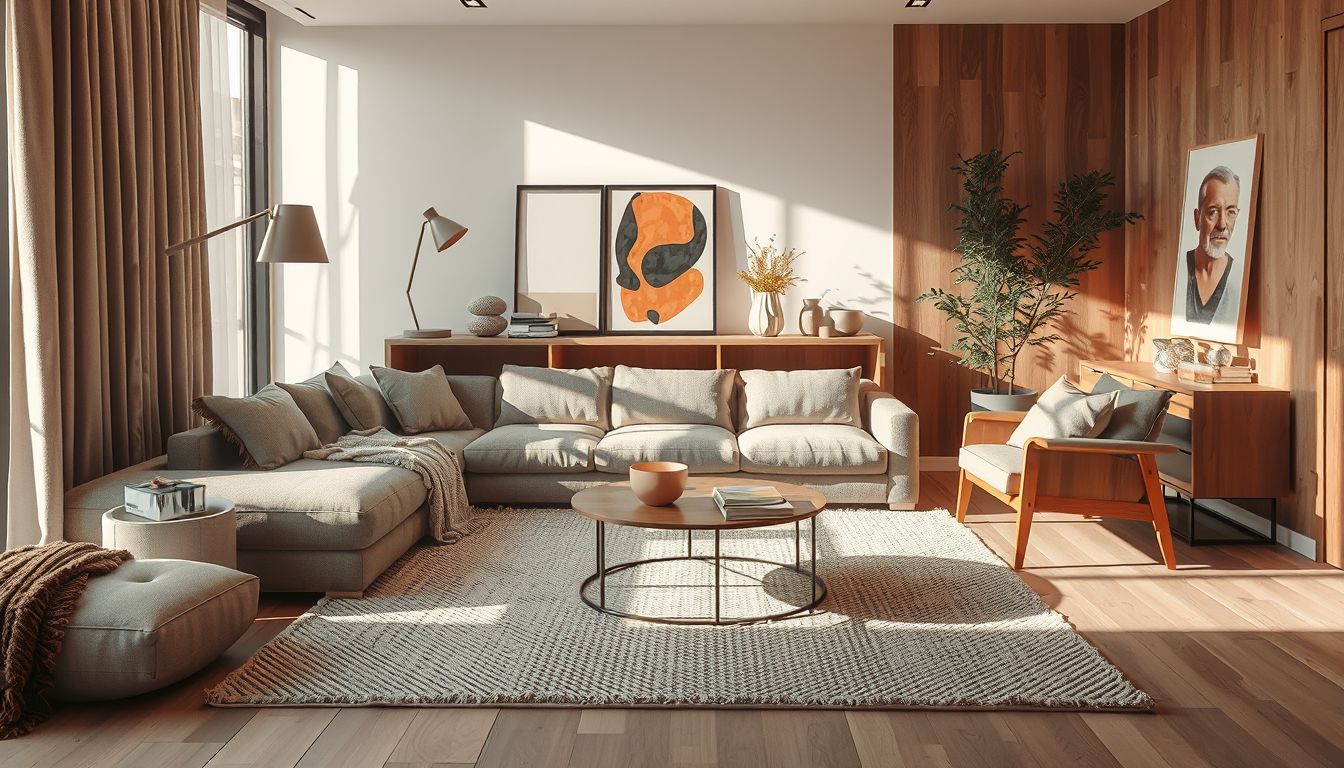
A removable rug small rental plan works best when each rug defines one activity zone. Start with a 160 × 230 cm living-room rug that reaches beneath the sofa’s front legs, or allow 60–75 cm beyond every edge of a dining table so chairs remain supported when pulled out (IKEA Canada; EQ3).
Last updated: April 1, 2026 Author: Toronto Interior Designer Editorial Team Meta description: Learn how removable rugs can define compact Toronto rental rooms without floor damage, bulky dividers or lease-end complications.
Removable rugs function as soft architecture: they organize living, dining and work areas without permanent walls or adhesive flooring. That flexibility is useful in Toronto rentals where one room may perform several functions, including a small-apartment media nook.
How Can a Removable Rug Define Zones in a Small Rental?
A rug creates a visual boundary by connecting the furniture used for one activity. When a sofa, coffee table and chair overlap the same rug, they read as a unified living zone; several undersized rugs can make the room appear fragmented (IKEA Canada; EQ3).
This approach is especially relevant in the GTA. New condominium units launched across the Greater Toronto and Hamilton Area averaged approximately 658 square feet in the first quarter of 2024 (Urbanation). In compact units, a floor-level boundary can preserve light and sightlines more effectively than a tall screen or bookcase.
A rug should show where an activity happens without becoming another obstacle in the room.
Explore related strategies in our living-spaces guides.
Why use a rug instead of a solid divider?
A low rug leaves windows, ceilings and adjacent areas visible, while a vertical divider can interrupt light and sightlines. In a CityPlace studio with one principal exterior window, that distinction may be more important than it is in a divided Junction apartment with windows in separate rooms.
A 120 × 180 cm rug can identify a compact desk area, but its final size should follow the desk footprint, chair movement and walking route. Test the proposed outline briefly with floor-safe painter’s tape, remove it promptly and confirm compatibility with the floor manufacturer or landlord before use (Ontario LTB).
For another non-permanent planning method, see our bagua-map layout guide.
How Should You Map a Small Rental Before Choosing a Removable Rug?
Source Scaled-Right Living Room Pieces
Start with apartment-scale sofas, nesting tables, and layered lighting that fit Toronto floor plans without overwhelming them.
Toronto Interior Designer may earn a commission if you shop through these links at no extra cost to you.
Begin with a measured floor plan showing furniture, baseboards, floor vents, balcony tracks and door swings. Mark the shortest route from the entrance to the main living area, then add rugs only where several objects need to read as one group.
We tested six scaled studio and one-bedroom layouts using common Toronto condo proportions. The clearest versions kept one uninterrupted circulation route and used no more than three rugs. This was an editorial layout exercise rather than an on-site building survey, so renters should verify every measurement in their own unit.
Placing a loose rug does not require a Toronto building permit, although regulated construction and structural alterations may require one (City of Toronto).
What rug sizes and budgets should you plan for?
These are practical 2026 planning allowances in Canadian dollars, based on advertised size and price bands from IKEA Canada, Simons Maison, Ruggable Canada and EQ3. Taxes, delivery charges, inventory and promotions can change the final cost (IKEA Canada; Simons Maison; Ruggable Canada; EQ3).
| Rental zone | Starting size | Placement target | 2026 CAD allowance |
|---|---|---|---|
| Living area | 160 × 230 cm | Sofa and chair front legs overlap | $149–$399 |
| Four-seat dining area | 200 × 300 cm | Approximately 60–75 cm beyond tabletop | $299–$699 |
| Compact desk | 120 × 180 cm | Desk and working chair fit within edges | $99–$249 |
| Entry | 60–80 × 180–250 cm | Clears the door and walking path | $69–$199 |
| Non-slip rug pad | Rug size minus 2–5 cm | Pad remains hidden at every edge | $35–$120 |
Confirm delivered dimensions before installation because rug measurements can vary slightly by material and manufacturing method (IKEA Canada).
Where Should You Place Removable Rugs in a Small Toronto Rental?
Place each rug far enough beneath its furniture that it reads as part of the activity zone rather than as an isolated mat. A living-room rug should reach the sofa, while a dining rug must support chairs in both tucked-in and pulled-out positions (IKEA Canada; EQ3).
A compact condo does not need a different colour for every zone. Repeating related neutrals can maintain continuity, while changes in weave or pattern distinguish activities. This is an editorial design recommendation rather than a building standard.
Before moving heavy furniture, check applicable condominium rules. Toronto condo tenants must follow their corporation’s declaration, bylaws and rules, which may include elevator reservations and permitted moving hours (Condominium Authority of Ontario).
How should you position a living-room rug?
Choose a rug wide enough to sit beneath at least the sofa’s front legs and, where possible, the front legs of adjacent chairs. This overlap connects the seating arrangement visually (IKEA Canada).
For a narrow Toronto one-bedroom, test a 160 × 230 cm rug lengthwise. If it obstructs a balcony door or puts a corner in the primary walking route, choose a smaller proportional size instead of folding the rug. Ruggable instructs customers to align its rug cover and pad on a flat surface rather than use the system folded (Ruggable Canada).
Keep strong patterns within the seating group so they do not compete with circulation areas. Coordinate the result with these renter-friendly décor upgrades.
How far should a dining rug extend?
Allow approximately 60–75 cm beyond every tabletop edge. This gives dining chairs enough rug surface to remain supported when pulled away from the table (IKEA Canada; EQ3).
A 90 × 150 cm table requires approximately 210 × 270 cm of floor coverage when calculated with a 60 cm allowance on all four sides. A commonly stocked 200 × 300 cm rug may work, but measure actual chair movement and nearby cabinetry before ordering.
In a combined kitchen and dining space, keep the rug outside appliance-door paths and food-preparation aisles. Our kitchen and dining guides offer additional circulation ideas.
Can a rug define a work-from-home zone?
Yes. A 120 × 180 cm low-pile rug can define a compact workstation when the desk feet and chair’s normal working position remain within its edges. Measure the chair while seated and pushed back because repeatedly crossing a thick edge can interfere with stable movement (CSA Group).
For a wall-facing desk, align the rug with the workstation instead of centring it in the entire room. A bound flatweave is generally easier for chair casters to cross than a deep pile, while a compatible pad can reduce movement (IKEA Canada).
If the desk shares a living room with a television, consult our small-apartment media nook and home-office guides.
What works at a Toronto rental entrance?
Use a low-pile runner that clears the entrance door through its complete swing. Measure the smallest gap between the door and finished floor, then select a rug-and-pad combination thinner than that measurement; product thickness varies by construction (IKEA Canada; Ruggable Canada).
A runner approximately 60–80 cm wide can guide movement through a narrow entry while leaving visible flooring around its edges. Toronto winter footwear also introduces snow, water and road salt, so choose a washable or readily cleaned surface and follow its care label (City of Toronto).
Never leave a damp rug on wood or laminate. Lift the runner periodically so moisture and floor changes can be identified early.
Which Removable Rug Materials and Pads Are Best for Small Rentals?
Low-pile and flatwoven rugs are usually the most manageable choices near doors, dining chairs and vacuum paths. Use a separate non-slip pad that is approved for the specific finished floor; the pad should remain hidden approximately 2–5 cm inside the rug edges (IKEA Canada).
“Washable” does not necessarily mean suitable for a condo laundry room. Compare the rug’s dimensions, folded bulk and pile with the washer capacity specified by the manufacturer. Ruggable assigns different machine-capacity requirements according to rug size and construction (Ruggable Canada).
Shared laundry rooms may also have posted restrictions on bulky items, so check the building’s rules before purchasing a large washable rug.
Which materials are easiest to maintain?
Machine-washable synthetic rugs suit spill-prone zones only when the complete rug fits the available washer under the manufacturer’s instructions (Ruggable Canada). Polypropylene flatweaves are commonly sold with straightforward surface-cleaning directions, while wool rugs require care appropriate to the individual product label (IKEA Canada).
For dining areas, prioritize a stable low pile and clear stain-care instructions. A thicker rug may be practical beside a bed, where office chairs and entrance doors are absent. Check every Canadian product listing for backing composition, shedding notes and cleaning restrictions.
Toronto shoppers can compare materials at EQ3 on King Street East or CB2’s Toronto location, but should confirm current inventory before travelling (EQ3; CB2 Canada).
Can rug tape damage rental flooring?
Yes. Adhesive tape can leave residue or affect some floor coatings, depending on the tape, finish, installation period and removal method. Use a floor-compatible non-slip pad first; if tape remains necessary, request the landlord’s written approval and follow both manufacturers’ instructions.
Ontario tenants may be responsible for wilful or negligent damage beyond ordinary wear, but tenancy guidance does not make every rug-tape product automatically acceptable or prohibited (Ontario LTB). Responsibility depends on the installation, evidence and resulting condition.
Photograph the bare floor before installation, retain the rug and pad labels, and inspect underneath after 30 days. Find more reversible options in our decor and accents guides.
Which Rug Mistakes Make a Small Toronto Rental Feel Smaller?
The most common mistake is using several small rugs that do not connect with surrounding furniture. The exposed gaps create competing visual boundaries, so begin with the fewest rugs needed to explain the layout.
Do not block entrance doors, balcony tracks, floor vents or the direct path through the apartment. Loose or curled rug edges can contribute to falls, and federal fall-prevention guidance recommends removing unsecured rugs or using non-slip backing (Public Health Agency of Canada).
Colour alone does not determine whether a room feels smaller. Contrast, pattern scale, furniture overlap and daylight all affect the result. A dark rug can anchor pale furniture in a bright Liberty Village condo, while a lower-contrast palette may preserve continuity in a basement apartment; these are editorial design scenarios, not universal rules.
What should you check before ordering?
Measure the usable floor, furniture footprint, door swings and primary walking route in centimetres. Mark the outline temporarily with a floor-approved product, view it from the entrance and seating area, and remove the marker promptly.
Verify the return policy, packaged weight and cleaning requirements. A 200 × 300 cm washable rug may meet a manufacturer’s machine specification but still be difficult to carry from a condo unit to shared laundry facilities (Ruggable Canada).
Finally, review the lease and condominium rules. Condo tenants must comply with applicable governing documents, while Ontario tenancy guidance distinguishes ordinary wear from undue damage (Condominium Authority of Ontario; Ontario LTB).
What Should You Know About Removable Rugs for Small Rentals?
The strongest plan uses one correctly sized, low-pile rug with a compatible non-slip pad for each genuinely separate activity. A larger rug works best where several seats must read as one arrangement; a smaller washable rug is often more practical at a wet entry or beside a bed.
Aim for one to three rugs in a studio, depending on whether the home contains distinct living, work, dining and entry zones. That range comes from our six-plan editorial test and is not a municipal or condominium standard.
The goal is not to cover every empty floor area. Each rug should explain the layout, support safe circulation and remain practical to clean, move and remove at the end of the tenancy.
Room Refresh Checklist
- Measure the room, furniture, doors and balcony tracks in centimetres.
- Place the sofa’s front legs on the living-area rug (IKEA Canada).
- Allow approximately 60–75 cm beyond each dining tabletop edge (IKEA Canada; EQ3).
- Preserve a direct route from the entrance to the principal living area.
- Confirm rug-pad compatibility with the finished floor.
- Check folded rug dimensions against the washer’s capacity (Ruggable Canada).
- Photograph the bare floor before installation.
- Review the lease and applicable condo rules (Ontario LTB; CAO).
- Retain receipts, product labels and care instructions.
- Inspect rug corners and the floor beneath them after 30 days.
Frequently Asked Questions
What size rug works in a small Toronto rental living room?
Start with approximately 160 × 230 cm if it reaches beneath the sofa’s front legs without obstructing doors or circulation. A rug that touches only the coffee table is less effective at connecting the seating group (IKEA Canada).
How far should a rug extend beyond a dining table?
Allow approximately 60–75 cm beyond every tabletop edge so chairs remain supported when pulled out (IKEA Canada; EQ3). A 90 × 150 cm table therefore needs about 210 × 270 cm of coverage when using a 60 cm allowance.
Can an Ontario tenant use rug tape?
Yes, but use it only after confirming floor compatibility and obtaining the landlord’s written approval. Photograph the floor before installation and inspect the taped area within 30 days because tenants may be responsible for negligent damage beyond ordinary wear (Ontario LTB).
Is a washable rug suitable for a condo washer?
Yes, but only when its size, folded bulk and pile match the manufacturer’s stated washer capacity. Check the exact model before buying a large rug such as 200 × 300 cm because washer requirements vary by construction (Ruggable Canada).
How many rugs should a studio apartment have?
Begin with 1–3 rugs: one for the living group, one optional dining or work zone, and one entry runner. This is an editorial recommendation based on six scaled layout tests, so use fewer rugs if exposed gaps make the studio feel fragmented.
Does Toronto require a permit for a removable rug?
No building permit is required simply to place 1 or more loose rugs in a Toronto rental. Permits apply to regulated construction and alterations, although renters must still follow their lease and any applicable condominium rules (City of Toronto; Condominium Authority of Ontario).
Sources
- City of Toronto — When Is a Building Permit Required?
- City of Toronto — Salt Management Plan
- Condominium Authority of Ontario — Renting a Condominium
- Ontario Landlord and Tenant Board — Renting in Ontario
- Urbanation — Condominium Market Research
- IKEA Canada — How to Choose the Right Rug Size
- EQ3 — Rugs and Rug Guidance
- Ruggable Canada — Washing and Care Instructions
- Public Health Agency of Canada — Safe Living Guide
- CSA Group — CSA Z1002
- CB2 Canada — Store Locations
Toronto Interior Designer Editorial Team | Toronto Design Research Desk The editorial team researches practical interiors for Toronto homeowners, condo residents and renters, with attention to Ontario tenancy guidance and compact GTA floor plans. Its guides combine Canadian product research with Toronto-specific layout and sourcing considerations. (/author/editorial-team/)
Finish the Room With Texture
Layer in rugs, side tables, and decor accents that warm up condo living rooms without adding clutter.
Toronto Interior Designer may earn a commission if you shop through these links at no extra cost to you.
Frequently Asked Questions
What size rug works in a small Toronto rental?
Start with a 160 × 230 cm living-room rug if it fits beneath the sofa’s front legs without obstructing doors. Measure all walking routes before ordering.
How far should a rug extend beyond a dining table?
Allow 60–75 cm beyond every tabletop edge so chairs remain on the rug when pulled out. A 90 × 150 cm table needs about 210 × 270 cm of coverage with a 60 cm allowance.
How many removable rugs should a studio apartment have?
Begin with 1–3 rugs for the living area, an optional dining or work zone, and the entrance. Use fewer if exposed gaps make the rental feel fragmented.
Toronto Interior Designer is editorially independent. Our recommendations are based on research and editorial judgment, not brand sponsorships.