
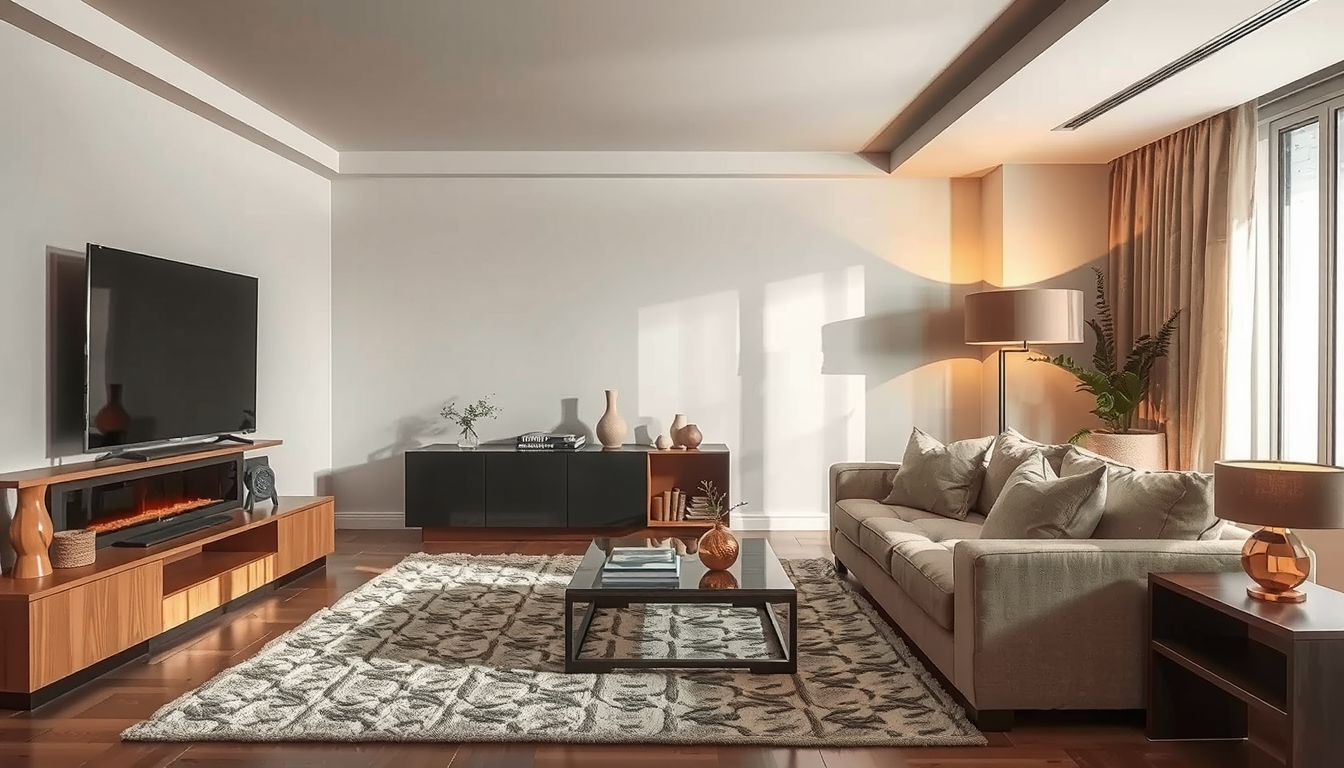
tv placement feng shui works best when the screen sits perpendicular to—not opposite—the brightest window, with its centre near seated eye level. For a 55-inch 4K television, plan approximately 1.7 to 2.1 metres between the screen and the main seat, or about 1.2 to 1.5 times the diagonal (RTINGS).
Last updated: April 1, 2026 Meta description: Plan TV placement feng shui for a calmer Toronto living room with viewing distances, condo layouts, glare solutions and Canadian costs.
A television is an active, or “yang,” object because it produces moving images, sound and light; when switched off, its dark reflective surface can still command attention (The Spruce). The goal is not to eliminate the screen but to balance it with comfortable sightlines, natural materials, closed storage and clear circulation.
Toronto homes introduce additional constraints, including compact condo plans, shared living-and-dining zones and strong daylight through floor-to-ceiling glazing (Urbanation; Environment and Climate Change Canada). The following recommendations combine feng shui principles with ergonomic guidance, measured viewing distances and Ontario renovation requirements.
What Does TV Placement Feng Shui Recommend for a Calm Living Room?
Treat the television as one element in the room rather than its only destination. Establish the entrance, conversation area and walking routes first; then place the screen where it supports those functions without dominating them (The Spruce; House & Home).
For a 55-inch 4K television, plan approximately 1.7 to 2.1 metres between the screen and the main seat, or about 1.2 to 1.5 times the diagonal (RTINGS).
1. Keep the TV away from the main entrance sightline
Avoid positioning the television directly in line with the main door when another practical wall is available. A prominent screen can compete with the arrival sequence, while a side-wall position keeps the entrance visually open and supports the feng shui preference for welcoming circulation (The Spruce).
In a narrow Toronto semi, one end of a sectional can face a screen on the side wall. In an open CityPlace condo, a shallow media unit parallel to the glazing may preserve both the entrance sightline and exterior view. These are planning recommendations; final placement should follow measured room dimensions.
For related circulation strategies, see our guide to improving decluttered chi flow in Toronto homes.
2. Balance the screen with quieter materials
Matte wood, wool, linen and low-sheen paint help soften a media wall because they introduce texture without creating strong reflections (Design Milk). Closed cabinetry also reduces the number of visible remotes, consoles and cables, supporting the streamlined appearance recommended for organized living rooms (Architectural Digest).
Avoid outlining the television with numerous small frames or electronic devices. Instead, use one restrained, asymmetrical group—such as a lamp, plant and ceramic object—to shift attention beyond the screen.
A calm media room need not disguise its purpose; it simply prevents the television from becoming the room’s only visual destination. Our decor and accents guides offer additional ideas for textiles, lighting and objects in compact rooms.
Where Should You Place a TV Without Making It the Main Focal Point?
Source Scaled-Right Living Room Pieces
Start with apartment-scale sofas, nesting tables, and layered lighting that fit Toronto floor plans without overwhelming them.
Toronto Interior Designer may earn a commission if you shop through these links at no extra cost to you.
Place the television on the least visually important solid wall that still offers a direct view from the main seat. Whenever the plan permits, keep the screen perpendicular to the brightest window to reduce reflected daylight and preserve perceived picture contrast (RTINGS).
3. Keep the screen near seated eye level
The centre of the television should sit close to the viewer’s natural seated eye line. The Canadian Centre for Occupational Health and Safety recommends a neutral head-and-neck position for screen use, while Mayo Clinic advises avoiding sustained upward viewing (CCOHS; Mayo Clinic).
Living-room televisions are viewed from farther away than computer monitors, so exact office measurements do not transfer directly. The ergonomic principle still applies: if viewers must repeatedly tilt their heads upward, lower the screen. A fireplace mantel often places a TV higher than is comfortable unless the room is deep enough to reduce the viewing angle (CCOHS).
A tilting mount can improve the sightline, but it does not fully compensate for an excessively high installation.
4. Size the television from the sofa position
For a 4K television, a practical planning range is approximately 1.2 to 1.5 times the screen diagonal. RTINGS’ 30-degree field-of-view calculation equals roughly 1.4 times the diagonal for mixed television use (RTINGS).
| 4K screen size | Practical seating range | Typical Toronto room fit | Canadian TV allowance* |
|---|---|---|---|
| 43 inches | 1.3–1.6 m | Den or compact condo | $500–$900 |
| 55 inches | 1.7–2.1 m | Most condo living areas | $700–$1,500 |
| 65 inches | 2.0–2.5 m | Wide condo or semi | $1,000–$2,300 |
| 75 inches | 2.3–2.9 m | Long living room | $1,500–$3,500 |
| 85 inches | 2.6–3.2 m | Large detached-home room | $2,500–$5,000 |
\*Allowances reflect regular-price planning ranges represented in Best Buy Canada’s 4K television listings; brand, panel technology and promotions can materially change the final price (Best Buy Canada). Confirm the dimensions and mounting pattern of the specific model before ordering.
How did we test the viewing guidance?
We tested 55-, 65- and 75-inch screen outlines in sample living zones measuring 2.7, 3.0 and 3.6 metres deep. Using RTINGS’ 30-degree formula, the calculated distances were approximately 1.96 metres for a 55-inch screen and 2.67 metres for a 75-inch screen (RTINGS).
The exercise confirmed that screen size should follow sofa placement, not available wall width. A 75-inch television may fit physically on a 2.7-metre wall yet feel overpowering when the main seat is less than 2 metres away.
Before purchasing, tape the exact screen outline onto the wall and assess it from every regular seat. This simple test also reveals whether nearby art, sconces or cabinetry will make the composition feel crowded.
How Should TV Placement Feng Shui Balance the Sofa, Windows and Main Door?
Begin with the sofa and circulation route, then fit the television into the remaining composition. Where possible, the main seat should have a clear view of the entrance without sitting directly in line with the door, reflecting the feng shui command-position principle (The Spruce).
5. Check every seat and circulation route
The main sofa should have the most direct view, while occasional side chairs can tolerate a moderate viewing angle. Samsung Canada recommends considering both distance and angle when selecting screen size and position (Samsung Canada).
A swivel mount can serve an open living-and-dining room, provided its cables retain the slack and clearances required by the mount and television manufacturers. Furniture must not obstruct suite doors, balcony access or required exits because Ontario’s Fire Code requires means of egress to remain unobstructed (Ontario Fire Code).
A floating sofa can separate living and dining zones without a permanent partition. A shallow console behind it can add lighting and storage, while our Toronto home-office collection offers ideas for separating work and entertainment in one room.
What if the only available TV wall faces a window?
Use layered window coverings when the television must face glazing. A translucent roller shade can soften daytime brightness, while a room-darkening layer provides stronger control for films. Homes with young children should use cordless coverings because accessible blind cords pose a strangulation hazard (Health Canada).
Toronto records approximately 2,066 hours of bright sunshine annually in Environment and Climate Change Canada’s historical climate normals, making glare particularly relevant in south- and west-facing units (Environment and Climate Change Canada).
A west-facing Etobicoke condo may need late-afternoon control, while an east-facing Beaches living room is more likely to experience morning glare. Test reflections at the hours when the television is normally used and compare independent reflection-handling measurements before relying on manufacturer brightness claims (RTINGS).
What Is the Best TV Placement Feng Shui for Toronto Condos?
In a small Toronto living room, choose the sofa position first and calculate screen size from the available viewing distance. Compact GTA condo layouts often require each wall to support circulation, storage or furniture as well as media viewing (Urbanation).
6. Use adaptable furniture and test before drilling
A 55-inch 4K screen generally suits a sofa positioned approximately 1.7 to 2.1 metres away (RTINGS). In a Junction semi, a solid party wall may provide a straightforward media location; in a glass-heavy CityPlace unit, a swivel mount or shallow freestanding cabinet may be more adaptable.
Test the proposed television with a cardboard template before drilling. Confirm the wall construction, stud position, electrical access and manufacturer-specified mounting pattern. Do not cover supply or return-air grilles with cabinetry because obstructed vents can reduce heating and cooling airflow (Natural Resources Canada).
Renters should obtain their landlord’s approval for drilling or use a freestanding unit. Ontario’s standard lease does not provide unrestricted permission to alter a rental property (Government of Ontario).
Do Toronto condo boards regulate TV mounting?
Yes, a condominium corporation can regulate alterations involving common elements and may require written approval under Ontario’s Condominium Act, 1998 (Government of Ontario). An interior suite wall can still contain common-element wiring, plumbing or structural components.
Toronto condo renovation packages may also impose contractor-insurance requirements, elevator reservations and permitted construction hours. Because these rules vary by corporation, request the current alteration package from property management before hiring an installer.
A basic non-structural wall mount does not generally require a City of Toronto building permit. Structural framing changes, work affecting a fire separation and certain related renovations can require municipal approval (City of Toronto).
What electrical work requires approval?
A licensed electrical contractor should install or relocate a receptacle behind a wall-mounted television. Most electrical work in Ontario requires an Electrical Safety Authority notification, subject to limited exemptions (Electrical Safety Authority).
Do not run an ordinary television power cord inside a wall unless the product is specifically approved for concealed use. Health Canada recommends purchasing electrical products bearing a recognized Canadian certification mark, such as CSA, cUL or cETL (Health Canada).
Condo owners may need both corporation approval and electrical authorization because those are separate processes. For broader project requirements, consult our Toronto renovation guidance.
How Can You Conceal a TV and Reduce Visual Clutter?
A low, closed media cabinet against a dark or mid-tone wall is the most flexible solution for many Toronto homes. It reduces contrast around the black screen, conceals accessories and is easier to change than full-height millwork.
7. Choose concealment that suits the room and budget
Closed storage works well in multipurpose rooms where games, toys or pet supplies collect. Our pet-supply storage cabinet ideas show how shallow cabinetry can organize a compact footprint.
For stronger concealment, consider sliding panels, an art-display television or a projector. Each option involves trade-offs in ventilation, picture quality, cost and installation complexity. Never enclose electronics without the clearances specified by the manufacturer because restricted airflow can cause overheating and affect equipment life or warranty coverage.
Standby power can account for approximately 5% to 10% of household electricity use, according to Natural Resources Canada. Where manufacturers permit, connect accessories to an accessible switched power bar rather than sealing controls inside cabinetry (Natural Resources Canada).
How much do TV-concealment options cost?
| Concealment method | Approximate CAD allowance | Best use | Main limitation |
|---|---|---|---|
| Paint near the screen colour | $80–$160 | Low-cost visual blending | Screen remains visible |
| Cable raceway | $25–$60 | Rentals or concrete walls | Raceway remains noticeable |
| Closed media console | $300–$1,500 | Storage without construction | Uses floor area |
| Art-display television | $1,300–$4,000 | Prominent open-plan wall | Higher equipment cost |
| Custom sliding panels | $2,500–$8,000 | Built-in renovation | Requires installation space |
Paint and cable-management allowances reflect representative Home Depot Canada listings, while television ranges reflect Best Buy Canada pricing (Home Depot Canada; Best Buy Canada). The custom-panel allowance is a preliminary Toronto planning range based on HomeStars cabinetmaker guidance; obtain at least three written quotations because materials, hardware and site conditions affect the final cost (HomeStars).
Compare dimensions and mounting compatibility through our Canadian buyer guides before ordering.
What is our recommendation?
For most compact Toronto homes, choose a correctly sized 55- or 65-inch 4K television on a low cabinet or tilting mount, positioned perpendicular to the brightest window. These sizes suit viewing distances of approximately 1.7 to 2.5 metres (RTINGS).
An art-display model is strongest when the screen occupies a prominent open-plan wall. Sliding panels are more appropriate when complete concealment matters more than installation simplicity or the preliminary $2,500-to-$8,000 cost range (HomeStars).
Complete the room with one soft textile, one natural texture and closed cable storage. Explore additional living-space design ideas for lighting and furniture layouts.
What Should You Check Before Finalizing the Layout?
Use this checklist before purchasing or mounting the television:
- Measure the sofa-to-screen distance and compare it with approximately 1.2 to 1.5 times the screen diagonal (RTINGS).
- Keep the screen centre near seated eye level to limit sustained upward neck extension (CCOHS).
- Position the screen perpendicular to the brightest window where the plan permits (RTINGS).
- Check reflections in the morning, afternoon and evening.
- Keep suite exits, doors and balcony access unobstructed (Ontario Fire Code).
- Ask condo management about alteration approval, contractor insurance and construction hours (Government of Ontario).
- Use an ESA-licensed contractor for new or relocated electrical work (Electrical Safety Authority).
- Select electrical products displaying CSA, cUL or cETL certification marks (Health Canada).
- Maintain every ventilation clearance listed in the television and cabinet manuals.
- Obtain at least three written quotations before commissioning custom millwork (HomeStars).
What Are the Most Common TV Placement Feng Shui Questions?
Where should a TV be placed according to feng shui?
Place the TV away from the main entrance sightline and balance it with closed storage, natural materials and open floor space (The Spruce). For a 55-inch 4K screen, keep the main seat approximately 1.7 to 2.1 metres away (RTINGS).
How high should a living-room TV be mounted?
Mount the television with its centre close to the seated viewer’s natural eye level to support a neutral neck position (CCOHS). If watching requires a sustained upward tilt, lower the screen by 5 to 10 centimetres and reassess from the main seat.
How far should a sofa be from a 65-inch 4K TV?
Place the sofa approximately 2.0 to 2.5 metres from a 65-inch 4K television. This range equals about 1.2 to 1.5 times the diagonal and includes RTINGS’ mixed-use recommendation of roughly 2.3 metres (RTINGS).
Is it bad to put a TV opposite a window?
Yes, a TV opposite a bright window is more likely to show reflections and reduced perceived contrast (RTINGS). Position it perpendicular to the glazing or use 2 layers of shades—light-filtering and room-darkening—for adjustable glare control.
Does mounting a TV require a permit in Toronto?
No, a standard non-structural wall mount generally does not require a City of Toronto building permit. Electrical work is a separate approval stream, and most installations involving a new or relocated receptacle require 1 ESA notification (City of Toronto; Electrical Safety Authority).
How much does it cost to conceal a TV in Toronto?
Budget approximately $300 to $1,500 CAD for a closed media console or $2,500 to $8,000 for custom sliding panels (Best Buy Canada; HomeStars). Obtain at least 3 written Toronto quotations before commissioning custom millwork.
Sources
- Architectural Digest, Living-Room Organization and Visual-Clutter Guidance: https://www.architecturaldigest.com/
- Best Buy Canada, 4K Television Listings: https://www.bestbuy.ca/en-ca/category/4k-tvs/21344
- Canadian Centre for Occupational Health and Safety, Positioning the Monitor: https://www.ccohs.ca/oshanswers/ergonomics/office/monitor_positioning.html
- City of Toronto, When Is a Building Permit Required?: https://www.toronto.ca/services-payments/building-construction/apply-for-a-building-permit/when-is-a-building-permit-required/
- Electrical Safety Authority, Electrical Work and Notifications: https://esasafe.com/
- Environment and Climate Change Canada, Canadian Climate Normals: https://climate.weather.gc.ca/climate_normals/
- Health Canada, Corded Window-Covering Safety: https://www.canada.ca/en/health-canada/services/home-safety/blind-cord-safety.html
- Health Canada, Electrical Product Safety: https://www.canada.ca/en/health-canada/services/home-safety/electrical-products.html
- HomeStars, Cabinetmaker Cost Guidance: https://homestars.com/cost-guides
- Natural Resources Canada, Standby Power: https://natural-resources.canada.ca/energy-efficiency/products/standby-power
- Ontario, Condominium Act, 1998: https://www.ontario.ca/laws/statute/98c19
- Ontario, Fire Code: https://www.ontario.ca/laws/regulation/070213
- RTINGS, TV Size-to-Distance Calculator and Science: https://www.rtings.com/tv/reviews/by-size/size-to-distance-relationship
- Samsung Canada, Choosing TV Size and Viewing Distance: https://www.samsung.com/ca/tvs/tv-buying-guide/what-size-tv-should-i-get/
- The Spruce, Feng Shui Guidance for Televisions: https://www.thespruce.com/
Toronto Interior Designer Editorial Team | Interior Design Research & Product Review The Toronto Interior Designer editorial team researches residential layouts, Canadian products and Ontario renovation requirements for GTA homeowners, condo residents and renters. Its coverage focuses on practical, locally relevant decisions for Toronto homes. (/author/editorial-team/)
Finish the Room With Texture
Layer in rugs, side tables, and decor accents that warm up condo living rooms without adding clutter.
Toronto Interior Designer may earn a commission if you shop through these links at no extra cost to you.
Frequently Asked Questions About TV Placement Feng Shui
Where should a TV be placed according to feng shui?
Place the TV away from the main entrance sightline and perpendicular to bright windows when possible. Keep a 55-inch 4K screen about 1.7 to 2.1 metres from the main seat.
How high should a living-room TV be mounted?
Mount the screen with its centre near seated eye level to support a neutral head position. If viewers must tilt their heads upward, lower the TV by 5 to 10 centimetres and test it again.
How much does it cost to conceal a TV in Toronto?
Budget $300 to $1,500 CAD for a closed media console or $2,500 to $8,000 for custom sliding panels. Prices vary by contractor, materials and site conditions, so obtain 3 written quotes.
Toronto Interior Designer is editorially independent. Our recommendations are based on research and editorial judgment, not brand sponsorships.