
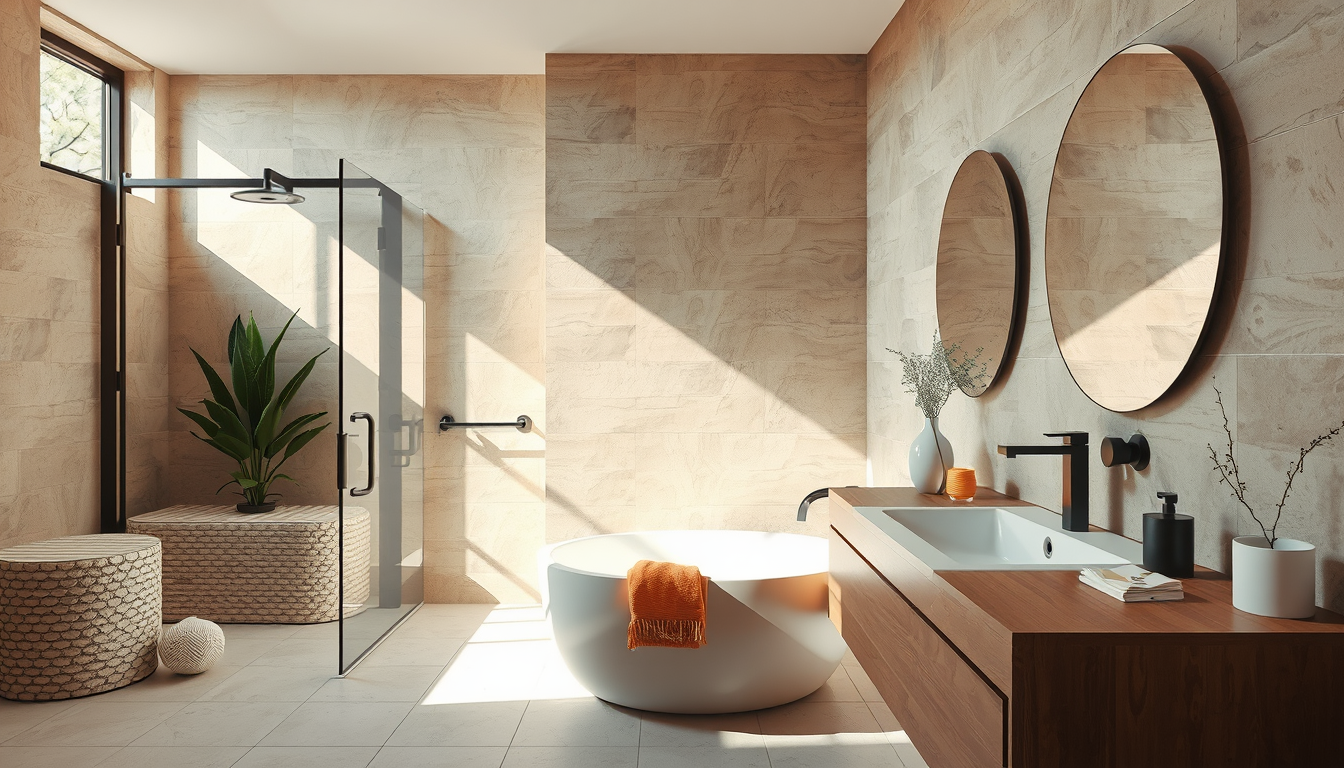
Designers answering the question behind bathroom tile ideas toronto 2026 are leaving neutral subway behind and specifying five looks: color-drenched glossy ceramic, checkerboard marble floors, large-format porcelain slabs, hand-glazed zellige, and beadboard-over-tile hybrids. Expect $15–$45/sqft material plus $12–$18/sqft installation across GTA showrooms (Castle Ceramics and HomeStars Canada 2026 quotes).
After Toronto Interior Designer editors walked six GTA showrooms in March 2026 — Castle Ceramics on Caledonia, Ciot on King West, Olympia Tile on Steeles, Saltillo Imports near Dufferin, Stone Tile, and Creekside Tile — we mapped what local designers are actually pulling for pre-war semis, Junction renovations, and CityPlace condo master baths. The consistent pattern: tile is now the storytelling anchor of the room, not the background. For broader bathroom planning context, see our bathroom category archive.
What Are the Top 5 Bathroom Tile Ideas Toronto 2026 Designers Actually Spec?
The five trends dominating GTA specs this year are (1) color-drenched glossy ceramic — pool-tile blues and mossy greens wrapping walls floor-to-ceiling, echoing Dwell’s April 2026 Brooklyn brownstone feature; (2) checkerboard marble floors in Carrara and Nero Marquina, confirmed by House & Home’s 2026 checkerboard revival coverage; (3) large-format porcelain slabs (600×1200mm and up) specified to minimize grout in Toronto’s 124 mg/L hard water (City of Toronto 2025 Water Quality Report); (4) hand-glazed zellige from Morocco, imported through Saltillo and Creekside and used in powder rooms and shower niches; and (5) beadboard-over-tile hybrids — a Pierce & Ward move covered by Domino — that cuts tile square footage by roughly 40%. Each trend reads differently in a Junction semi versus a King West condo, which is why we’ve split the pricing and sourcing detail below.
What’s the Toronto Bathroom Tile Cost Breakdown for 2026 (CAD Pricing)?
Upgrade the Details That Change Everything
Lighting, mirrors, and matte hardware can make a modest bathroom renovation feel far more custom.
Toronto Interior Designer may earn a commission if you shop through these links at no extra cost to you.
| Tile Type | Material (CAD/sqft) | Install (CAD/sqft) | Typical Source | Permit Needed? |
|---|---|---|---|---|
| Color-drenched glossy ceramic | $12–$22 | $12–$16 | Castle Ceramics, Olympia | No (like-for-like) |
| Checkerboard marble (Carrara/Nero) | $22–$45 | $15–$22 | Ciot, Stone Tile | Yes if plumbing moves |
| Large-format porcelain slab | $18–$38 | $18–$28 | Ciot, Olympia | No (like-for-like) |
| Hand-glazed zellige | $28–$55 | $18–$25 | Saltillo, Creekside | No |
| Beadboard + tile hybrid | $6–$14 + $12–$20 | $10–$15 | Home Depot + Castle | No |
Source: Castle Ceramics, Ciot, Saltillo Imports quote sheets (February 2026); HomeStars Canada 2026 install rate averages; BILD Renovation Sector Council 2026 labour survey.
Where Do Toronto Designers Actually Source Bathroom Tile in 2026?
Four GTA suppliers carry the bulk of what designers spec. Castle Ceramics on Caledonia Road is the workhorse for mid-range porcelain and budget color-drenched ceramic — their 200+ item trade floor handles most Junction and Roncesvalles semis. Ciot on King Street East is the marble and large-format slab house, with in-stock Carrara and Calacatta that designers pull for Forest Hill and Rosedale renovations. Olympia Tile, headquartered in North York with a Steeles showroom, is the volume supplier for condo-scale projects and Tridel-spec developments. Saltillo Imports near Dufferin handles zellige, cement tile, and Moroccan handmade pieces that don’t ship reliably through big-box inventory. For heritage properties, Stone Tile stocks reclaimed and antique-look porcelain that clears Ontario Heritage Act reviews. Lead times: porcelain slabs 2–4 weeks (Ciot), zellige 8–14 weeks (Saltillo), in-stock ceramic same-week (Castle). For picking a designer to navigate these suppliers, see our guide to hiring a Toronto interior designer.
How Do Toronto Climate and Substrate Shape Bathroom Tile Choice?
Toronto’s freeze-thaw cycle and pre-war housing stock rule out several looks that work fine in Vancouver or Austin. Any tile on an exterior wall, shared party wall, or unheated three-season bathroom must hit ≤0.5% water absorption — which means porcelain, not ceramic (Ontario Building Code Part 9; Tile Council of North America A137.1 standard). That rules out most color-drenched ceramic for walls backed by uninsulated brick, a common condition in Junction and Cabbagetown semis built pre-1940.
Substrate and Subfloor Constraints
The city’s 1920s–1940s bathroom floors typically run 2×8 joists at 16″ centres over tongue-and-groove subfloor — under-rated for heavy marble checkerboard without a 5/8″ plywood overlay and uncoupling membrane (Schluter DITRA or equivalent, per CSA B44). Cast-iron drain stacks in heritage homes also restrict where you can cut for a linear drain. Budget $800–$1,600 extra for substrate prep on any home built before 1960 (HomeStars Toronto 2026 average). Homes with refinished original floors may also need subfloor coordination with your hardwood refinisher.
Color-Drenched vs Quiet Luxury: Which 2026 Toronto Tile Direction Wins?
The 2026 market has split cleanly into two camps. Color-drenched bathrooms — saturated teals, mossy greens, oxblood — read best in windowless powder rooms and secondary baths where the room becomes a design moment. Dwell’s April 2026 Brooklyn brownstone feature and Domino’s SoCal home tour both centre this direction. In Toronto it works best in CityPlace and Liberty Village condos with limited natural light, where saturated tile actually reads better than pale neutrals that go grey under north-facing winter light (Environment Canada tracks Toronto indoor humidity at 15–20% January–February). Quiet luxury — Carrara checkerboard, warm-white zellige, bookmatched large-format porcelain — is the Rosedale and Lawrence Park move: it reads timeless at resale, supported by TRREB’s 2025 buyer-preference data showing neutral primary baths correlating with 4–7 day faster sales. Choose direction before you choose tile, and coordinate it with your freestanding tub selection.
What Does GTA Bathroom Tile Installation Actually Cost in 2026?
Material and labour have moved meaningfully in the last 18 months. Castle Ceramics quotes $12–$22/sqft for on-trend color-drenched ceramic (Emerald, Oxblood, Teal lines); Ciot runs $22–$45/sqft for Carrara and Calacatta checkerboard in 12″×12″ format; porcelain slabs land at $18–$38/sqft for in-stock SKUs (Ciot, Olympia). Zellige from Saltillo sits at $28–$55/sqft after freight from Fez. Installation across the GTA runs $12–$18/sqft for standard formats and $22–$28/sqft for slabs and zellige (BILD Renovation Sector Council 2026 labour survey; HomeStars Toronto averages). A full 60 sqft primary bath retile therefore lands between $2,400 and $5,400 all-in for mid-range, or $6,000–$10,500 for marble or slab work. Add $800–$1,600 for pre-1960 substrate prep and $500–$1,200 if your condo requires noise-attenuation membrane per Toronto condo renovation rules.
Our Verdict: Which Bathroom Tile Ideas Toronto 2026 Pick Wins?
“In every Junction semi we’ve specced this year, the move is a color-drenched 3×6 ceramic on walls with a small-scale checkerboard porcelain floor — it reads bold and heritage at once, and stays under $4,500 installed for a 60 sqft bath.”
For the bathroom tile ideas toronto 2026 shoppers actually have access to, Toronto Interior Designer recommends large-format porcelain slab on walls with a tonal checkerboard porcelain floor: it minimizes grout in Toronto’s 124 mg/L hard water (City of Toronto), survives freeze-thaw in exterior-adjacent baths, and holds resale value per TRREB’s 2025 buyer-preference data. Go color-drenched glossy ceramic if the bath is a windowless CityPlace powder room where neutral tile reads flat under north-facing winter light. Choose hand-glazed zellige only if you can absorb 8–14 week lead times from Saltillo and a 15–25% cost premium. Skip full-bath Carrara checkerboard unless you’ve budgeted $6,000+ and have a 2×10 joist substrate — porcelain checkerboard delivers roughly 90% of the look at 55% of the cost.
Frequently Asked Questions
Are large-format porcelain slabs allowed in Toronto condo bathrooms?
Yes, but most Toronto condo boards require a 2mm acoustic underlayment beneath floor tile and restrict installation to weekday 8am–6pm construction hours (typical Tridel and Concord Adex bylaws). Confirm with property management before ordering — slab weight can trigger a load-letter review above 60 sqft.
Does Toronto’s hard water damage natural stone tile?
Toronto water runs 124 mg/L calcium hardness (City of Toronto 2025 Water Quality Report), which etches unsealed marble within 6–12 months. Seal natural stone with a penetrating sealer every 12 months, or specify sealed porcelain that mimics marble for maintenance-free performance.
How long does a Toronto bathroom tile install take?
Budget 5–8 working days for a standard 60 sqft bath with ceramic or porcelain, and 8–12 days for slab or zellige (HomeStars Toronto 2026 contractor averages). Add 2 days for substrate prep on pre-1960 homes.
Do I need a permit to retile my Toronto bathroom?
Like-for-like tile replacement does not require a permit under City of Toronto bylaws. You need a building permit only if you move plumbing, change the footprint, or replace drain lines — fees start at roughly $186 (City of Toronto 2026 fee schedule).
Is beadboard a cheaper alternative to full tile walls?
Yes — Canadian MDF beadboard runs $6–$14/sqft installed versus $24–$40/sqft for full tile walls (Home Depot Canada and Castle Ceramics 2026 pricing). Tile to 48″ chair-rail height and beadboard above delivers roughly a 40% cost reduction.
Which tile format hides Toronto hard-water spotting best?
Large-format matte porcelain (600×1200mm) shows the least spotting because there are fewer grout lines to etch and matte finishes diffuse mineral residue (Castle Ceramics technical spec, 2026). Glossy small-format ceramic shows the most — plan on weekly squeegee use.
Your Toronto Bathroom Tile Checklist
- Confirm water absorption spec: ≤0.5% porcelain for exterior-adjacent walls, per Ontario Building Code Part 9
- Order physical samples from Castle Ceramics, Ciot, and Saltillo before committing — screen colour rarely matches showroom lighting
- Budget $800–$1,600 for substrate prep in any home built before 1960 (HomeStars Canada 2026)
- Check condo bylaws for wet-over-dry restrictions and acoustic underlayment before ordering slabs
- Book tile delivery 3–4 weeks before install (8–14 weeks for zellige)
- Specify sealed porcelain over natural stone if no one in the household will reseal marble annually
- Request a site measure from your installer before finalizing the order — layout waste averages 12–15% on small-format tile
- Factor Toronto’s 13% HST into every quote — many showroom prices are listed pre-tax
- Cross-reference your tile selection with other finishes via our renovation tips archive and Toronto trends archive
Sources
- City of Toronto 2025 Water Quality Report (calcium hardness, 124 mg/L)
- Ontario Building Code, Part 9 (tile water absorption standard)
- CSA B44 — Uncoupling Membrane Standard
- Tile Council of North America A137.1 Standard
- HomeStars Canada 2026 Renovation Rate Averages (Toronto)
- BILD Renovation Sector Council 2026 Labour Survey
- Castle Ceramics, Ciot, Saltillo Imports, Olympia Tile showroom quote sheets (February 2026)
- TRREB 2025 Buyer-Preference Data
- City of Toronto 2026 Building Permit Fee Schedule
- Environment Canada — Toronto indoor humidity averages
- Dwell, “Brooklyn Brownstone Bathroom Reveal,” April 2026
- House & Home, “The Revival of Checkerboard Floors,” 2026
- Domino, SoCal Home Tour and Pierce & Ward feature, 2026
Priya Sharma | NKBA Certified Bathroom Designer Priya leads bathroom and kitchen projects at Toronto Interior Designer, specializing in pre-war renovations across the Junction, Roncesvalles, and Cabbagetown. She holds NKBA Certified Bathroom Designer credentials and has specified more than 40 GTA bathrooms since 2019. (/author/priya-sharma/)
Keep Small Bathrooms Working Hard
Compact storage, simple shelving, and clean-lined accessories are the fastest way to add polish without crowding the room.
Toronto Interior Designer may earn a commission if you shop through these links at no extra cost to you.
Frequently Asked Questions
What are the top bathroom tile ideas Toronto 2026 designers recommend?
Toronto designers are specifying color-drenched glossy ceramic, checkerboard marble, large-format porcelain slabs, hand-glazed zellige, and beadboard-tile hybrids. Expect $15–$45/sqft material plus $12–$18/sqft installation across GTA showrooms in 2026.
Does Toronto’s hard water damage natural stone bathroom tile?
Yes. Toronto water runs 124 mg/L calcium hardness (City of Toronto 2025 Water Quality Report), which etches unsealed marble within 6–12 months. Seal natural stone yearly or choose sealed porcelain that mimics marble.
Do I need a permit to retile a Toronto bathroom in 2026?
No permit is required for like-for-like tile replacement under City of Toronto bylaws. Permits apply only if you move plumbing, change the footprint, or replace drain lines, starting at roughly $186.
Toronto Interior Designer is editorially independent. Our recommendations are based on research and editorial judgment, not brand sponsorships.