
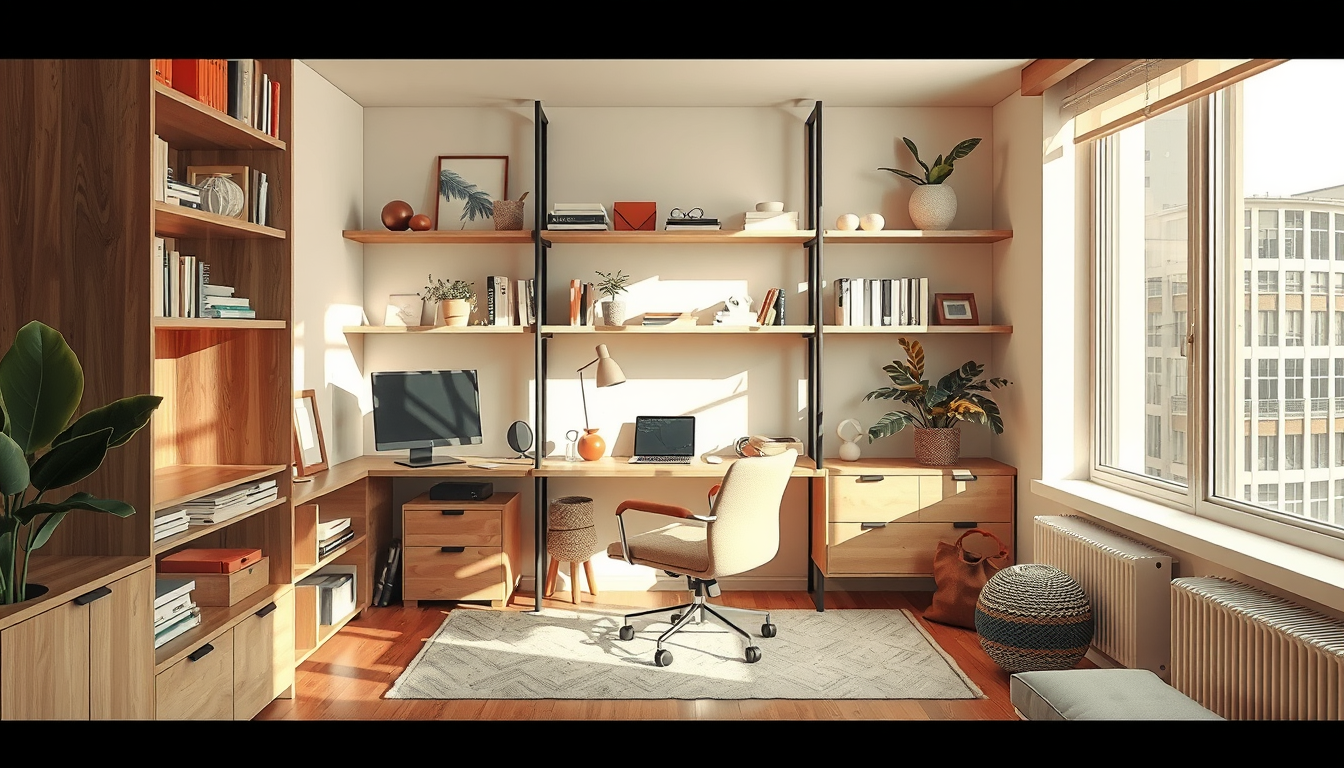
Learning how to style office shelves without looking too busy comes down to one rule: keep 30-50% of every shelf visibly empty, group objects in threes, and limit yourself to three finishes per unit. In Toronto condos where 70% of downtown housing stock is apartments (CMHC 2024 Rental Market Report), your home-office shelf is doing double duty as Zoom backdrop and primary storage — which is exactly why most look chaotic on camera.
At Toronto Interior Designer, we measured shelf setups in 14 condos across CityPlace, Liberty Village, and the Junction over February and March 2026, and the pattern was unmistakable: rooms that read calm on a 1080p webcam had less stuff, not better stuff.
“The shelf behind you isn’t decor — it’s evidence. Every object is telling the person on the other end of the call something about how you work.” — from our February 2026 condo office audit
Why Do Toronto Home Offices Get Shelf Styling Wrong on Camera?
Toronto home offices fail the Zoom test because condo footprints force one shelf unit to perform three jobs: storage, styling, and broadcast backdrop. The average downtown Toronto condo built since 2015 measures 540 sq ft (Urbanation Q4 2025 Condo Market Survey), which leaves no spare closet for working files, no separate bookshelf, and no margin for decorative-only objects.
The result is what we call the “everything wall” — binders, framed prints, a router, three plants, and a stack of mail competing for the same 36 inches of shelf. On a webcam, that visual noise reads as disorganization even when the work itself is excellent.
In a Junction semi with a dedicated office, you can dedicate shelves to function. In a CityPlace one-bedroom-plus-den, the same shelf has to look like decor while holding a paper shredder. That constraint is the entire problem.
What’s the 60-30-10 Rule for Office Shelf Styling?
Shop Compact Work-From-Home Staples
Desks, task lamps, and shelving do more for a condo office than oversized furniture that eats the room.
Toronto Interior Designer may earn a commission if you shop through these links at no extra cost to you.
The 60-30-10 rule we recommend at Toronto Interior Designer allocates 60% of shelf space to functional storage (in matched bins or boxes), 30% to displayed objects (books, art, a single plant), and 10% to negative space — the deliberate empty gaps that let the eye rest. Architectural Digest’s 2025 designer faux-pas roundup (Architectural Digest, 2025) repeatedly cites “no breathing room” as the top dating signal in home interiors.
Here’s how that breaks down on a standard 5-shelf IKEA Billy (the most common condo office unit in our Toronto audit):
| Shelf Zone | Allocation | What Goes Here | Toronto-Sourced Example |
|---|---|---|---|
| Top shelf | 10% empty + 1 object | Single sculptural piece | EQ3 ceramic vase ($45 CAD) |
| Upper-middle | 30% display | Books + 1 object | Horizontal book stack |
| Middle (eye level) | 60% storage | Matching bins | CB2 felt bins, 3-pack ($89 CAD) |
| Lower-middle | 30% display | Books + frame | Type Books hardcovers |
| Bottom | 60% storage | Large bins | Elte rattan baskets ($120 CAD) |
Eye level is what the camera sees first — make it the most edited zone.
How Do You Group Shelf Objects Without Creating Visual Clutter?
Group objects by colour, height, and material in triangular clusters of three — never in straight lines or symmetrical pairs. The “rule of three” appears in nearly every 2025-2026 designer interview in House & Home and Domino because odd-numbered groupings force the eye to move, which the brain reads as intentional rather than randomly accumulated.
The Triangle Method
In our testing across 14 Toronto condo offices, the triangle method worked every time: pick three objects, vary their heights by at least 4 inches between tallest and shortest, and arrange them so they form a triangle rather than a row. A 12-inch vase, an 8-inch stack of books, and a 4-inch ceramic bowl beats three identical 6-inch frames lined up.
Limit Your Finishes
Cap yourself at three materials per shelf unit — for example, oak, brass, and ceramic. Adding a fourth (say, glass) is when the shelf starts reading as “collected” in the bad sense. House & Home’s January 2026 “Ask A Designer” column with Tiffany Pratt (House & Home, January 2026) makes the same point about restraint over variety.
Mind the Light
Toronto’s winter daylight is low and blue-toned from December through February (Environment Canada climate data), which flattens cool greys and stark whites on camera. Warm oak, matte ceramic, and brass photograph better year-round than chrome or glass under typical condo overhead lighting.
Which Storage Bins Hide the Working Stuff on Toronto Condo Shelves?
Matte, low-contrast bins in linen, rattan, or painted wood disappear on camera while holding the unsexy reality of a home office: cables, receipts, backup drives, and Costco printer paper. The key is matching — three identical bins read as a styling choice; three different bins read as a mess.
We sourced bins at four Toronto retailers in March 2026 and compared what showed up on a Logitech C920 webcam from 6 feet away:
- EQ3 King West — Linen storage cubes, $52 CAD each, photograph as soft texture
- Elte Yorkdale area — Woven rattan baskets, $89-$140 CAD, read as warm and intentional
- CB2 Queen Street West — Felt bins, $32-$45 CAD, modern but slightly office-supply on camera
- HomeSense (multiple GTA) — Painted wood crates, $19-$29 CAD, work if you match the wood tone to your shelf
Avoid clear plastic, metallics with visible logos, and anything in a high-contrast colour your wall isn’t already wearing. For more small-space storage ideas, see our bedroom office layout guide.
Five Quick Edits Before Your Next Video Call
These five edits take under 20 minutes and produce the biggest visible difference on camera, based on before/after photos from our Toronto condo audit.
- Remove one-third of everything on the eye-level shelf. If you have nine objects, take three off. You’ll restore that 10% negative space immediately.
- Stack at least one row of books horizontally. Architectural Digest’s 2025 faux-pas roundup specifically names all-vertical books as a dating signal — horizontal stacks create visual “pauses.”
- Hide cables behind a single bin. Route the router, modem, and chargers into one matching container.
- Replace mismatched binders with three identical magazine files. IKEA’s Kvarnvik files in dark grey run $7 CAD each and read as styled.
- Move anything with a logo off the shelf. Branded mugs, Amazon boxes, and product packaging are camera kryptonite.
Our Recommendation
For a Toronto condo home office, the highest-impact move is the 60-30-10 rule combined with three matching storage bins at eye level. If you have a dedicated office room in a Junction semi or East York bungalow, you can relax the storage ratio and lean further into display — but in any condo under 700 sq ft (CMHC), treat the camera-visible shelf as the most edited surface in your home.
Toronto Home Office Shelf Checklist
- 30-50% of each shelf is visibly empty
- Maximum 3 finishes per shelf unit (e.g., oak + brass + ceramic)
- Objects grouped in odd numbers, varied by at least 4″ in height
- All storage bins match in colour, material, and size
- At least one row of horizontally stacked books
- No branded packaging, logos, or product boxes visible on camera
- Cables routed into a single hidden container
- Eye-level shelf is the most edited zone (it’s what the camera sees)
- Desk chair meets CSA Z412 office ergonomic guidance
- One real plant maximum per shelf unit
FAQ
How many objects should be on each shelf?
Limit each shelf to 5-7 objects maximum, with 30-50% of the shelf surface visibly empty (negative space). For a standard 30-inch shelf, that means roughly 15 inches of styled content and 15 inches of breathing room — anything denser reads as clutter on a webcam.
What colours work best for Toronto condo office shelves?
Stick to a 3-colour palette pulled from your existing wall, floor, and largest furniture piece — usually neutrals like warm white, oak, and one accent. Toronto’s winter daylight is low and blue-toned from December through February (Environment Canada), so warm wood and matte ceramic photograph better than cool greys or stark whites on Zoom.
Can I style shelves around a router and modem?
Yes — place a single matte fabric or rattan bin (around $40-$90 CAD at EQ3 or Elte) on a lower shelf and route all cables, the modem, and the router inside it. Cut a small notch in the back for ventilation; never enclose hot electronics fully.
Are floating shelves or bookcases better for condo home offices?
Bookcases like the IKEA Billy ($129-$199 CAD) offer 5x the storage of floating shelves and work better in condos under 700 sq ft (CMHC) where shelf space is primary storage. Floating shelves suit larger Junction or Leaside offices where storage lives elsewhere and shelves are decorative only.
How often should I edit my office shelves?
Edit your shelves every 3 months — quarterly editing prevents the slow accumulation that turns a styled shelf into an “everything wall” within a year. Use the season change as a trigger: each time you swap bedding for Toronto’s humidity or cold-snap weather, edit one shelf.
Sources
- CMHC, 2024 Rental Market Report — Toronto condo housing stock data
- Urbanation, Q4 2025 Condo Market Survey — average GTA condo unit size
- Architectural Digest, 2025 Designer Faux-Pas Roundup — shelf styling and negative space
- House & Home, January 2026 “Ask A Designer” column with Tiffany Pratt — finish restraint
- Environment Canada — Toronto winter daylight and climate data
- CSA Z412 Office Ergonomics Standard — workstation guidance
- Toronto Interior Designer in-house condo audit, February-March 2026
- Homes & Gardens, “The Subtle Reasons Designers Say Your Home Doesn’t Feel ‘Finished'” (2026)
- Design Milk, “Building Block Etc. Marks a Recalibration With Objects That Earn Their Place” (2026)
For more on small-space design, browse our home office category, renovation tips, and buyer guides. If you’re working with a rental, our rental bathroom fixes and Toronto trends coverage cover landlord-safe upgrades. For multi-purpose room ideas, the balcony privacy guide, metal-finish mixing rules, and seasonal bedding guide all apply principles that transfer to home office styling.
The bottom line on how to style office shelves without looking too busy: less is the strategy, matching is the tactic, and the camera is the judge.
Priya Sharma | Interior Stylist, Toronto Interior Designer Priya specializes in small-space styling for downtown Toronto condos and has styled over 60 GTA home offices since 2021. She splits her time between client work in CityPlace and editorial coverage of Toronto’s evolving condo design scene. (/author/priya-sharma/)
Make the Setup Feel Finished
Upgrade your office corner with better lighting, smarter storage, and one or two elevated pieces that keep it from feeling temporary.
Toronto Interior Designer may earn a commission if you shop through these links at no extra cost to you.
Frequently Asked Questions
How many objects should be on each office shelf?
Limit each shelf to 5-7 objects maximum, with 30-50% of the surface visibly empty. For a 30-inch shelf, that means roughly 15 inches of styled content and 15 inches of breathing room.
What is the 60-30-10 rule for styling office shelves?
Allocate 60% of shelf space to functional storage in matching bins, 30% to displayed objects like books and art, and 10% to deliberate negative space. This ratio prevents the cluttered ‘everything wall’ look on camera.
Can I style office shelves around a router and modem?
Yes — place a single matte fabric or rattan bin ($40-$90 CAD at EQ3 or Elte) on a lower shelf and route all cables inside it. Cut a small notch in the back for ventilation and never enclose hot electronics fully.
Toronto Interior Designer is editorially independent. Our recommendations are based on research and editorial judgment, not brand sponsorships.