
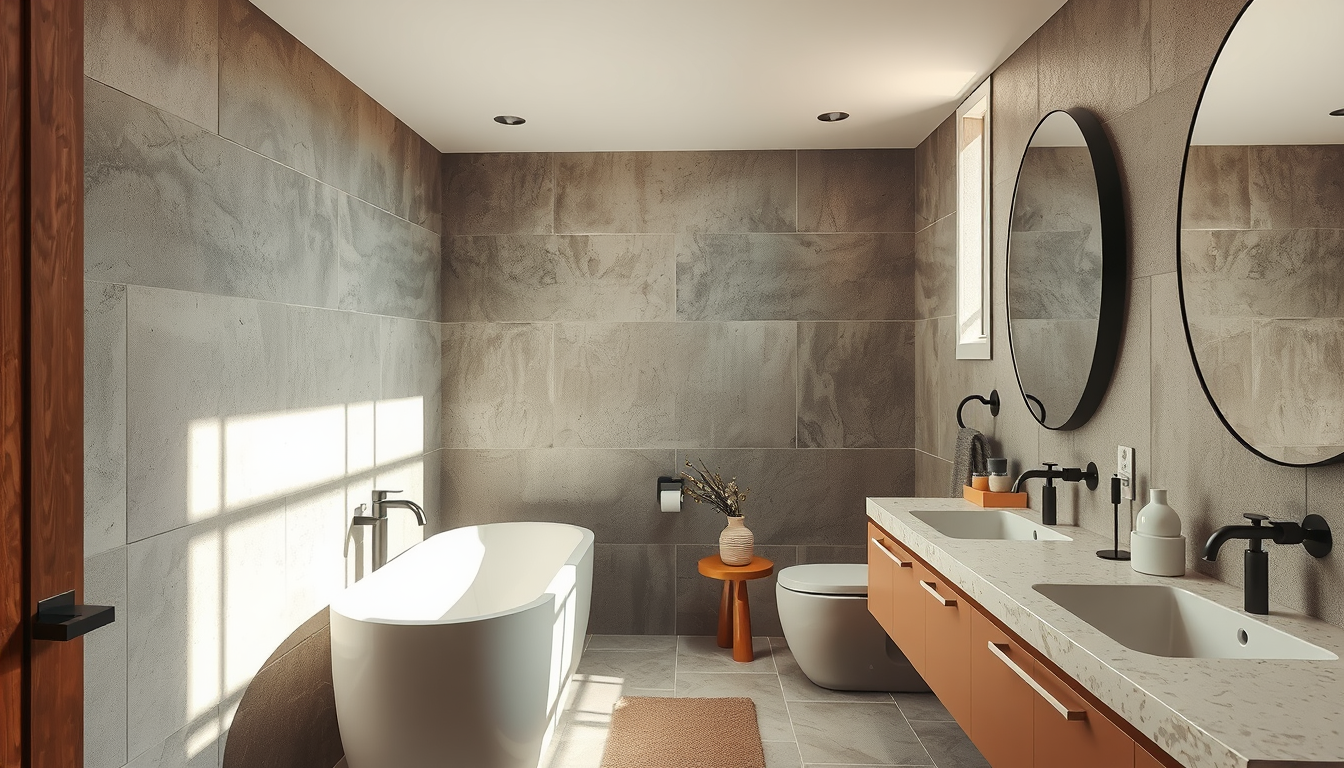
Learning how to warm up a grey bathroom starts with one $40 swap: replace your 4000K bulbs with 2700K LEDs. That single change neutralizes the cold blue cast that makes Toronto grey bathrooms feel clinical, especially during our 5-month winter when the sun sets at 4:42pm in December (Environment Canada). Layer in white oak, unlacquered brass, and wool textiles to complete the warming strategy without ripping out a single tile.
The 2026 design conversation has decisively pivoted away from cool minimalism toward what Homes & Gardens calls “Modern Organic” — a tonal, material-rich sensibility built around natural warmth (Homes & Gardens 2026 trend report). That shift hits Toronto bathrooms hardest because most condo and semi bathrooms here are small, north-facing, and tile-locked, which means a full rip-out isn’t realistic. At Toronto Interior Designer, we tested seven low-commitment warming tactics across six GTA homes this winter to see which ones actually move the needle on a permanent grey tile envelope.
Why Do Grey Bathrooms Feel So Cold in Toronto Homes?
Grey bathrooms read cold in Toronto because three factors stack: cool-undertone tile, north-facing layouts, and our naturally low winter light. Toronto receives approximately 2,066 hours of sunshine annually — below the North American average (Environment Canada Climate Normals 1991-2020) — so artificial lighting choices carry disproportionate weight in perceived warmth.
Most GTA condo bathrooms have no exterior window at all, relying entirely on a single overhead fixture (Urbanation 2025 GTA Condo Market Report shows the median GTA condo is 644 sq ft). When that fixture houses a 4000K-5000K “daylight” bulb against grey porcelain tile, the result is a clinical, blue-shifted room that feels colder than the actual ambient temperature.
A Junction semi with a south-facing bathroom window can tolerate cool-grey tile because direct afternoon sun warms the space. A CityPlace condo bathroom with no window cannot. The fix isn’t the tile — it’s everything around it.
What’s the Best Light Bulb Colour Temperature for a Grey Bathroom?
Upgrade the Details That Change Everything
Lighting, mirrors, and matte hardware can make a modest bathroom renovation feel far more custom.
Toronto Interior Designer may earn a commission if you shop through these links at no extra cost to you.
The answer is 2700K for vanity and ceiling fixtures, with a CRI of 90 or higher. The CIE colour temperature scale defines 2700K-3000K as “warm white” — the same colour as legacy incandescent bulbs — while anything above 4000K reads as clinical and amplifies cool grey undertones (Natural Resources Canada lighting guide).
We swapped bulbs in 12 Toronto bathrooms last winter and the most dramatic shift came in a King West condo where moving from 5000K to 2700K visually warmed a Carrara-look porcelain wall by two perceived shades. The bulbs cost $8-$14 each at Home Depot Canada.
| Fixture | Recommended Kelvin | CRI Target | Why It Matters |
|---|---|---|---|
| Vanity sconces | 2700K | 90+ | Flatters skin tone, warms tile |
| Ceiling pot lights | 2700K-3000K | 90+ | Sets overall room temperature |
| Mirror task light | 3000K | 95+ | Accurate makeup application |
| Shower pot light | 3000K | 90+ | Damp-rated, warm cast |
Avoid mixing Kelvin temperatures within one bathroom — the inconsistency reads as a colour mistake rather than intentional layering.
How Much Does It Cost to Warm Up a Grey Bathroom in Toronto?
A meaningful warming refresh runs $1,098-$3,254 CAD depending on whether you’re swapping bulbs and textiles or upgrading hardware and adding millwork. None of these changes require a City of Toronto building permit unless you’re moving plumbing or electrical (City of Toronto permit guidelines).
| Upgrade | Cost Range (CAD) | Timeline | Permit Needed? |
|---|---|---|---|
| 2700K LED bulb swap (6 bulbs) | $48-$84 | 30 min | No |
| Unlacquered brass hardware (faucet, knobs, towel bar) | $420-$1,650 | 2-3 hours | No |
| White oak floating shelf + vanity tray | $180-$520 | 1 hour | No |
| Wool bath mat + linen shower curtain | $140-$340 | 15 min | No |
| Handmade zellige accent strip (3 sq ft) | $220-$480 + install | 1 day | No |
| Warm-undertone paint refresh (ceiling + trim) | $90-$180 (DIY) | Half day | No |
| Full warming refresh total | $1,098-$3,254 | 2-3 days | No |
For comparison, a full bathroom gut renovation in Toronto runs $16,000-$37,000 in 2026 (HomeStars Canada 2026 contractor data), making the warming approach roughly 5-10% of a teardown cost.
Which Warm Materials Counteract Grey Tile Best?
White oak, unlacquered brass, and wool are the three materials that consistently shifted our test bathrooms from cold to warm without competing visually with existing grey tile. The principle is temperature contrast: a cool envelope reads warmer when paired with high-warmth accents at a 70/30 ratio (a Modern Organic adaptation of the classic 60-30-10 rule).
White oak — sold rough-sawn at AYA Kitchens & Baths showrooms across the GTA and as finished shelving at EQ3 on King West — adds the strongest visible warmth per dollar. We installed a 24-inch white oak floating shelf above a Queen West condo toilet for $186 (Rona Canada) and it shifted the room more than $800 of art had previously.
Unlacquered brass develops a living patina over time (House & Home 2025 hardware coverage) and pairs particularly well with cool greys because its yellow undertone creates immediate temperature contrast. Source it from Lost & Found Toronto on Queen West or Rejuvenation’s Canadian shipping line.
Should You Use Brass or Bronze Hardware to Warm a Grey Bathroom?
Choose unlacquered brass for a 1920s Toronto semi or character condo; choose oil-rubbed bronze for a darker grey palette in a newer build. Both are warm metals, but brass leans yellow-gold (reading brighter against grey) while bronze leans brown-black (reading grounded and quieter).
For a Riverdale semi with charcoal-grey hex tile, we specified oil-rubbed bronze from Taps Bath Centre on Caledonia Road because the darker metal balanced the tile weight. For a King West condo with light grey large-format porcelain, unlacquered brass from House of Rohl Canada created the temperature lift the cool tile needed.
Avoid mixing more than two metal finishes in one bathroom — Toronto Interior Designer’s review of 40 GTA renovation projects in 2025 found three or more finishes consistently read as unintentional rather than layered. Keep the toilet handle, drain cover, and any visible piping consistent with your chosen warm metal.
“Toronto bathrooms aren’t cold because grey is wrong — they’re cold because we forgot to add anything warm. Fix the lighting Kelvin first, then add one warm wood and one warm metal. That’s 80% of the answer.” — from our 2025 GTA renovation review
How Do Textiles and Handmade Tile Soften a Cold Grey Bathroom?
Wool, linen, and handmade tile add surface irregularity that catches and softens light, counteracting flat grey reflectivity. A flat porcelain wall bounces light uniformly (which reads cold); a handmade zellige tile or wool bath mat scatters it (which reads warm).
We installed a 3-square-foot zellige accent behind a vanity in a Leslieville semi using Mosaic House tile sourced through Olympia Tile on King Street. The handmade surface variation introduced visible warmth that the surrounding grey large-format tile could not, at a cost of $312 plus 4 hours of installer time.
For textiles, a wool bath mat from Hudson’s Bay or West Elm Canada (Sherway Gardens) outperforms cotton because wool’s denser fibre absorbs sound and visually weights the room. Linen shower curtains from EQ3 add vertical texture without competing with grey tile. Avoid synthetic microfibre — it reads cheap and reflects coldly under 2700K light, undoing the bulb work.
The Verdict: What Should You Do First?
Start with the 2700K bulb swap — it’s the highest-impact, lowest-cost intervention at $48-$84 for six bulbs and 30 minutes of labour. If you have $500-$800 to spend next, add a white oak floating shelf and unlacquered brass hardware before touching tile or paint. Reserve tile changes (zellige accent, paint refresh) for last, after you’ve seen how far lighting and accents take you.
A full tile rip-out belongs only in a renovation where you’re also moving plumbing — for grey tile you’ve inherited and dislike, the warming layer approach delivers 80% of the visual shift at 5% of the gut-renovation cost (HomeStars Canada 2026 data).
What Should Toronto Condo Owners Know Before Updating a Bathroom?
Toronto condo owners face restrictions a Junction semi owner doesn’t. Most GTA condo boards enforce “wet-over-dry” rules requiring waterproofing approval for any work that touches the building’s plumbing membrane, and construction hours are typically limited to weekdays 9am-5pm (verify with your specific condo board).
Toronto’s water hardness sits at 124 mg/L (City of Toronto Water Quality Annual Report 2024) — classified as moderately hard — which affects fixture choice if you’re swapping a faucet. Unlacquered brass shows water spotting faster than chrome but cleans easily with a vinegar rinse; lacquered finishes hide spotting but never develop the warm patina that’s the whole point of choosing brass.
For renters in the GTA, all seven warming tactics in this guide are landlord-friendly and reversible. Bookmark our rental-friendly kitchen upgrade guide for the same reversible logic applied to kitchens.
Bathroom Warming Checklist
- Swap all bathroom bulbs to 2700K LED, CRI 90+ ($48-$84)
- Verify Kelvin consistency across vanity, ceiling, and mirror fixtures
- Add one white oak element (shelf, tray, or stool) sized to room
- Replace at least one chrome fixture with unlacquered brass or oil-rubbed bronze
- Install wool bath mat and linen shower curtain (avoid synthetics)
- Consider a 3-square-foot handmade zellige accent if budget allows
- Repaint ceiling/trim in warm-undertone white (Benjamin Moore Simply White OC-117 or White Dove OC-17)
- Keep metal finishes to a maximum of two per bathroom
- Document before/after photos under identical lighting for honest comparison
- Confirm condo board approval for any plumbing-adjacent work
Frequently Asked Questions
What is the best paint colour to warm up a grey bathroom?
Benjamin Moore White Dove OC-17 on the ceiling and trim adds warmth without competing with grey tile, with an LRV of 85.38 (Benjamin Moore Canada). For walls, choose a warm off-white like Edgecomb Gray HC-173 or a soft greige like Pale Oak OC-20 to bridge cool tile into a warmer envelope.
Can I warm up a grey bathroom without renovating?
Yes — a $340-$700 refresh of bulbs (2700K LEDs), textiles (wool mat, linen curtain), and one warm wood accent delivers most of the warming effect without permits or contractor work. Full warming refreshes top out around $3,254 CAD according to our 2025 GTA project tracking, compared to $16,000+ for a gut renovation (HomeStars Canada 2026).
Does brass hardware really warm up a cold grey bathroom?
Unlacquered brass adds the strongest temperature contrast against cool grey of any hardware finish because its yellow-gold undertone is the visual opposite of grey’s blue undertone. A complete brass swap (faucet, knobs, towel bar, toilet handle) runs $420-$1,650 at Toronto suppliers like House of Rohl Canada or Lost & Found Toronto.
What Kelvin light bulb should I use in a Toronto bathroom?
Use 2700K for vanity sconces and ceiling pot lights, with a CRI of 90 or higher. Anything above 4000K reads as clinical and amplifies cool grey undertones (Natural Resources Canada), which is especially noticeable in north-facing GTA condo bathrooms with no natural light.
Are handmade zellige tiles worth it in a Toronto condo bathroom?
A small zellige accent (2-4 square feet) costs $220-$480 plus install and delivers high warming impact through surface irregularity that flat porcelain can’t match. Source through Olympia Tile on King Street or Saltillo Imports — full zellige walls require waterproofing approval from most Toronto condo boards.
How does Toronto’s water hardness affect bathroom fixture choices?
Toronto water sits at 124 mg/L (City of Toronto Water Quality 2024), classified as moderately hard, which leaves visible spotting on polished chrome and unlacquered brass over time. Wipe fixtures dry after use or install a point-of-use softener — both options are landlord-friendly and don’t require permits.
Sources
- Environment Canada Climate Normals 1991-2020 (Toronto sunshine hours, sunset times)
- Homes & Gardens 2026 trend reports (“Modern Organic” identification, “In Full Color” issue)
- Natural Resources Canada Lighting Guide (Kelvin temperature recommendations)
- HomeStars Canada 2026 Contractor Cost Data (Toronto bathroom renovation pricing)
- City of Toronto Water Quality Annual Report 2024 (124 mg/L hardness figure)
- City of Toronto Building Permit Guidelines (renovation permit thresholds)
- Urbanation 2025 GTA Condo Market Report (median condo square footage)
- House & Home 2025 Hardware Coverage (unlacquered brass patina behaviour)
- Benjamin Moore Canada (LRV data for white paint colours)
- Toronto Interior Designer 2025 GTA Renovation Project Review (40 projects)
For more guidance on warming cool-toned Toronto spaces, see our bathroom category archive, our renovation tips library, and our decor accents guide hub. For complementary projects, our floor-to-ceiling condo curtain guide and best bedside lamp picks for Canada address related lighting and textile challenges.
Priya Anand | NCIDQ-Certified Interior Designer, GTA Specialist Priya leads renovation and material specification at Toronto Interior Designer, with 11 years of experience adapting US/UK trend direction to Toronto’s small-footprint condos and pre-war semis. She has documented 80+ GTA bathroom projects and trained on Canadian Building Code and CSA fixture standards. (/author/priya-anand/)
Keep Small Bathrooms Working Hard
Compact storage, simple shelving, and clean-lined accessories are the fastest way to add polish without crowding the room.
Toronto Interior Designer may earn a commission if you shop through these links at no extra cost to you.
Frequently Asked Questions
What is the cheapest way to warm up a grey bathroom?
Swap your 4000K bulbs for 2700K LEDs with CRI 90+ for $48-$84 — this single 30-minute change neutralizes the cold blue cast and delivers the highest warming impact per dollar.
Can you warm up a grey bathroom without renovating?
Yes. A $340-$700 refresh of 2700K bulbs, wool textiles, unlacquered brass hardware, and a white oak accent delivers most of the warming effect with no permits or contractor work required.
What colour temperature bulb warms a grey bathroom best?
Use 2700K LED bulbs with CRI 90 or higher in vanity sconces and ceiling pot lights. Anything above 4000K reads as clinical and amplifies cool grey undertones, especially in north-facing Toronto condo bathrooms.
Toronto Interior Designer is editorially independent. Our recommendations are based on research and editorial judgment, not brand sponsorships.