
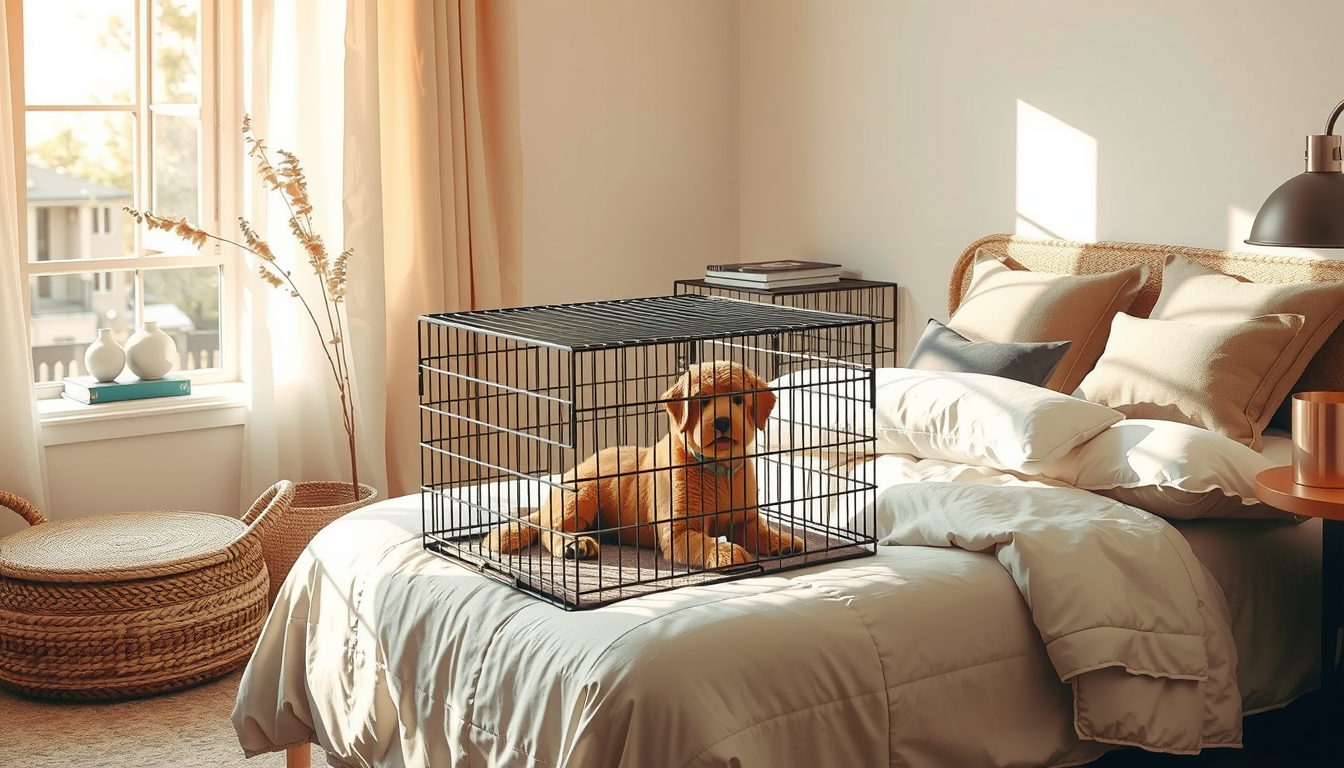
A dog crate furniture nook should use an independent, open-sided shell around a correctly sized wire crate, allowing the dog to stand, turn and lie fully extended (Ontario SPCA). This dual-purpose approach is particularly practical in Toronto, where newly completed GTA condominiums averaged just 658 square feet in 2024 (Urbanation Q4 2024).
Last updated: April 1, 2026 Meta description: Design a safe dog crate furniture nook for a Toronto bedroom with practical guidance on sizing, ventilation, placement, budgets and renter-friendly options.
Why Does a Dog Crate Furniture Nook Work in a Toronto Bedroom?
A furniture-style nook combines the crate with a nightstand, bench or storage surface, reducing the number of separate pieces competing for floor space. That efficiency matters in compact CityPlace condos and older Junction semis with shallow bedroom alcoves.
The furniture must remain secondary to the dog’s needs. The crate should allow the animal to stand without crouching, turn comfortably and lie fully extended (Ontario SPCA). It also needs unobstructed airflow and reliable access to its door and latches (MidWest Homes for Pets).
For a cohesive result, repeat proportions or finishes from the room’s existing bedroom design details. Built-in inspiration can also be drawn from these Rosedale storage solutions.
The best nook looks like furniture to the homeowner while continuing to function as a safe, well-ventilated crate for the dog.
What Should You Budget in Toronto?
Allow approximately $180 to $7,000 CAD, depending on whether the nook uses a simple tabletop or custom cabinetry. These are 2026 planning allowances based on Canadian retail listings and reported cabinetry labour ranges, not contractor quotes (IKEA Canada; CB2 Canada; HomeStars Canada 2026).
| Nook type | 2026 planning budget | Best Toronto application | Main limitation |
|---|---|---|---|
| Wire crate with freestanding tabletop | $180–$450 | Rental or small condo | Less visually integrated |
| Crate beneath a ready-made console | $450–$1,200 | Condo bedroom with a long wall | Fixed dimensions can restrict airflow |
| Modular cabinet surround | $1,200–$3,000 | CityPlace or Liberty Village condo | Requires precise field measurements |
| Custom millwork nook | $3,000–$7,000 | Junction semi or Rosedale house | Highest cost and least portable |
Obtain at least 3 written quotes for custom work because access, finish quality, electrical coordination and condo construction rules can materially affect the total (CHBA).
Where Should You Place a Dog Crate Furniture Nook?
Build a Warm, Layered Bedroom
Prioritize bedding, bedside lighting, and storage pieces that make small bedrooms feel softer and more restful.
Toronto Interior Designer may earn a commission if you shop through these links at no extra cost to you.
Choose a quiet wall with a clear approach, stable temperature and no conflict with bedroom circulation. Keep the nook away from radiators, portable heaters, floor registers and windows receiving intense afternoon sun because enclosed furniture can retain heat (Health Canada; crate manufacturer instructions).
In a high-rise, avoid sharing a wall with a neighbouring suite when possible. Scratching and movement can transfer through demising assemblies, making an interior closet wall a more considerate location (National Research Council Canada).
The nook must not obstruct the bedroom exit, balcony door or required access to heating equipment (Toronto Fire Services; Ontario Building Code). Leave enough room for the crate door to open completely without striking the bed, nightstand or dresser.
How Much Circulation Space Should You Preserve?
Tape the proposed footprint on the floor before purchasing furniture. Test the route with the bedroom door, closet doors, drawers and crate door fully open.
We tested 600-, 750- and 900-millimetre bedside zones in scaled Toronto condo plans. The 750-millimetre zone was the first to accommodate many medium crates without pushing the open crate door into the bed path; this is an editorial planning observation, not a universal code requirement.
Ontario accessibility guidance frequently uses an 850-millimetre clear doorway as a design reference, although private bedrooms are not automatically subject to every public accessibility standard (Ontario Building Code; Design of Public Spaces Standards). Preserve the widest practical route and explore similar principles in our accessible closet layout guide.
What Rules Apply to Condos and Rentals?
Condo owners should review their corporation’s declaration, bylaws and renovation rules before fastening furniture to walls. Ontario condo corporations can establish approval procedures, construction hours and elevator-booking requirements (Condominium Authority of Ontario).
Renters should choose a freestanding surround and obtain written landlord permission before drilling or making permanent alterations. Ontario’s standard lease does not automatically authorize physical modifications to a rental unit (Ontario Ministry of Municipal Affairs and Housing).
Concrete walls, party walls and walls containing building services require particular care. Confirm approved fastener locations with property management before installation, even when the furniture manufacturer supplies anchoring hardware (Condominium Authority of Ontario).
How Should You Size a Dog Crate Furniture Nook?
Size the crate to the individual dog before designing the surrounding furniture. The dog must be able to stand naturally, turn around and lie fully extended inside the crate (Ontario SPCA).
Measure standing height from the floor to the top of the head or ears, whichever is higher. Measure body length from the nose to the base of the tail, then compare both figures with the manufacturer’s internal dimensions rather than relying only on breed or weight labels (Petmate).
If the dog uses thick orthopaedic bedding, include its compressed height when checking headroom. Senior dogs may also benefit from a low threshold and a non-slip approach (Ontario SPCA).
Which Crate Size Fits Common Furniture Proportions?
Common nominal crate lengths range from 24 to 48 inches, but exterior dimensions vary by manufacturer and model (Petmate; MidWest Homes for Pets).
| Typical crate label | Common exterior length | Furniture form to consider | Critical measurement |
|---|---|---|---|
| Small | 24 in. / 61 cm | Wide nightstand | Standing height |
| Medium | 30 in. / 76 cm | Bedside console | Door swing and latch |
| Intermediate | 36 in. / 91 cm | Short bench | Full lying length |
| Large | 42 in. / 107 cm | Long bench or built-in | Room circulation |
| Extra-large | 48 in. / 122 cm | Custom low cabinet | Access and floor area |
These dimensions are measuring references, not breed guarantees. Confirm the manufacturer’s internal measurements and recommended weight range before ordering (Petmate; MidWest Homes for Pets).
How Much Space Should Surround the Crate?
Record the crate’s widest exterior points, including handles, latches, hinges and projecting door hardware. The furniture opening must not interfere with these components or prevent the crate from folding and operating as designed (crate manufacturer instructions).
There is no universal 1- or 2-inch clearance suitable for every crate cabinet. Required space depends on the crate design, furniture materials, room temperature and ventilation pattern, so follow both manufacturers’ instructions.
The removable tray must remain accessible without dismantling permanent cabinetry. If the crate expands or flexes during normal use, the surrounding shell must not trap its panels or distort its frame.
How Can a Dog Crate Furniture Nook Look Like Custom Furniture?
Choose one clear furniture identity: nightstand, bench or low built-in. Crates around 24 to 30 inches long can resemble substantial nightstands, while 36- to 48-inch models generally suit bench or console proportions (Petmate; MidWest Homes for Pets).
Repeat one existing bedroom detail, such as an oak edge, black pull, painted panel or rounded corner. Matching the wall colour can help a larger surround recede, while matching the bed frame makes it read as part of a coordinated suite.
A recessed plinth, flush end panels and aligned drawer fronts create a tailored appearance. Our Rosedale millwork budget guide explains how simplified cabinet boxes and upgraded fronts can balance cost and finish.
Which Construction Method Is Safest?
Use an independent structural shell instead of placing a heavy slab directly on a wire crate. A wire crate should not be assumed to support a person, television, stone top or loaded storage cabinet unless its manufacturer expressly permits that use (MidWest Homes for Pets).
Support the top with furniture-grade side panels or a tested table frame. Follow the stated load rating and use manufacturer-approved wall restraints where required, as anchoring top-heavy furniture reduces tip-over risk (Health Canada).
Keep screws, brackets and cut edges outside the dog’s reach. Decorative battens should be positioned so the dog cannot trap a paw, push its head through or chew the material (Ontario SPCA).
Which Materials and Toronto Retailers Make Sense?
Paint-grade plywood can create a durable open-front shell with fewer joints than modular particleboard. Specify low-emission coatings and allow paints, adhesives and sealants to cure for the manufacturer’s full stated period before use (Health Canada).
IKEA Canada offers economical tabletops and removable organizers, while CB2 on Queen Street West and EQ3’s Toronto showroom provide higher-priced nightstands and benches for proportion and finish references. Product dimensions and availability can change, so compare current listings with the crate’s measured exterior size (IKEA Canada; CB2 Canada; EQ3).
For restrained styling ideas, see these budget décor upgrades.
What Works Best for Renters?
Use a freestanding, table-style surround that lifts away from the crate without modifying it. Adjustable levelling feet can stabilize the furniture on uneven flooring, while removable felt pads can protect the finish when used according to the flooring manufacturer’s instructions.
Do not attach panels to the crate door, alter its lock or obstruct the hinges of a folding model (crate manufacturer instructions). A removable textile panel can soften the view, but it must not block airflow.
A reversible design is easier to move between GTA rentals with different bedroom dimensions. Review our other buyer guides before selecting storage furniture or washable textiles.
How Do You Keep a Dog Crate Furniture Nook Safe and Ventilated?
Keep multiple sides substantially open; narrow decorative slots should not automatically be treated as adequate ventilation. Solid cabinetry can retain heat, especially beside radiators, HVAC supplies or sun-heated windows (Health Canada).
Health Canada recommends maintaining indoor relative humidity between 30% and 50%. Monitor the nook through Toronto’s dry heating season and humid summer weather rather than choosing bedding solely according to the outdoor season (Health Canada).
Use a removable waterproof tray, machine-washable bedding and wipeable interior surfaces. Allow all coatings and adhesives to cure fully before the dog enters the nook, and increase room ventilation while using products that release volatile organic compounds (Health Canada).
Which Safety Details Need a Final Check?
Specify rounded edges, protected corners and inaccessible fasteners. Remove collars or harnesses during unsupervised crating when the manufacturer identifies an entanglement risk (MidWest Homes for Pets).
Make sure the door opens fully and that its lock remains visible and reachable. Never allow drawer fronts, curtains or decorative panels to interfere with the latch.
Inspect the furniture regularly for loose fasteners, chewed components or heat buildup. The crate and tray should be removable so every interior surface can be cleaned and examined.
What Should You Check Before Installing a Dog Crate Furniture Nook?
Non-structural built-in cabinetry generally does not require a Toronto building permit when it leaves plumbing, structure and HVAC systems unchanged (City of Toronto). Structural work or alterations to mechanical and electrical systems may require permits, notifications or inspections (City of Toronto; Electrical Safety Authority).
Our recommendation is an independent, open-sided shell around a correctly sized wire crate. Custom millwork suits an awkward house alcove, while a removable tabletop surround offers greater flexibility for renters and frequent movers.
For wider project-planning guidance, consult our Toronto renovation tips.
Bedroom Upgrade Checklist
- Confirm the dog can stand, turn and lie fully extended (Ontario SPCA).
- Measure the crate, including handles, latches and open-door swing.
- Keep multiple sides open for ventilation.
- Avoid radiators, registers, heaters and strong afternoon sun.
- Preserve access to bedroom, closet and balcony doors.
- Review condo rules or obtain written landlord permission.
- Give the furniture top independent structural support.
- Anchor tip-prone furniture with approved hardware.
- Use low-emission finishes and observe full curing times.
- Add a removable tray and washable bedding.
- Obtain at least 3 quotes for custom millwork (CHBA).
Sources
- Canadian Home Builders’ Association, renovation and contractor-planning guidance.
- City of Toronto, building-permit and residential-renovation guidance.
- Condominium Authority of Ontario, governing documents and renovation guidance.
- Electrical Safety Authority, Ontario notification and inspection requirements.
- Health Canada, indoor humidity, extreme heat, volatile organic compounds and furniture tip-over guidance.
- HomeStars Canada, 2026 cabinetry and custom-renovation cost guides.
- Ontario Ministry of Municipal Affairs and Housing, Ontario Building Code and standard lease information.
- Ontario SPCA and Humane Society, crate selection and animal-safety guidance.
- Urbanation, Q4 2024 GTA Condominium Market Survey.
- Petmate and MidWest Homes for Pets, crate dimensions, sizing and safety instructions.
- IKEA Canada, CB2 Canada and EQ3, Canadian product listings.
Frequently Asked Questions
How Big Should a Bedroom Dog Crate Be?
A bedroom crate should let the dog stand without crouching, turn around and lie fully extended (Ontario SPCA). Nominal lengths commonly range from 24 to 48 inches, but choose according to the individual dog and the manufacturer’s internal dimensions (Petmate).
Can You Put a Wire Dog Crate Inside a Cabinet?
Yes, provided the cabinet leaves multiple sides open and does not obstruct the door, tray, hinges or latches. Do not rely on an arbitrary 1- or 2-inch gap; use the crate and furniture manufacturers’ ventilation and clearance instructions.
Does a Dog-Crate Cabinet Need a Toronto Building Permit?
Usually no, because removable or non-structural cabinetry generally falls outside Toronto’s permit process (City of Toronto). Approval may be required if the project changes 1 or more structural, HVAC, plumbing or electrical systems (City of Toronto; Electrical Safety Authority).
How Much Does Custom Dog-Crate Furniture Cost in Toronto?
Budget approximately $3,000 to $7,000 CAD for a custom Toronto millwork nook based on 2026 cabinetry allowances (HomeStars Canada 2026). Compare at least 3 written quotes because access, finish quality and condo construction requirements can substantially change the price (CHBA).
What Indoor Humidity Is Best for a Crate Nook?
Aim for 30% to 50% relative humidity, the range recommended for Canadian homes (Health Canada). Monitor the nook during Toronto’s winter heating season and humid summer months, keeping it away from radiators and supply vents.
Can Renters Install a Crate Nook Without Damaging the Bedroom?
Yes, a freestanding open-sided surround can fit over the crate without wall attachment. Keep the design reversible and obtain written permission before drilling even 1 anchor hole or making another permanent alteration (Ontario Ministry of Municipal Affairs and Housing).
Toronto Interior Designer Editorial Team | Toronto Residential Design Editors The Toronto Interior Designer editorial team produces practical, source-led guidance for condo owners, renters and homeowners across the GTA. Its coverage focuses on compact layouts, Canadian products and renovation requirements affecting Toronto interiors. (/author/editorial-team/)
Shop Bedroom Essentials Without Guesswork
Use Canadian-friendly retailers with straightforward sizing and finish options before committing to larger pieces.
Toronto Interior Designer may earn a commission if you shop through these links at no extra cost to you.
Frequently Asked Questions
How big should a bedroom dog crate be?
Choose a crate that lets your dog stand without crouching, turn around and lie fully extended. Common crate lengths are 24 to 48 inches, but always check the manufacturer’s internal dimensions.
Can you put a wire dog crate inside a cabinet?
Yes, if the cabinet preserves unobstructed airflow on multiple sides and does not interfere with the crate door, hinges or latches. Follow the crate and cabinet manufacturers’ clearance instructions.
How much does custom dog crate furniture cost in Toronto?
Budget approximately $3,000 to $7,000 CAD for a custom millwork nook. Prices vary by contractor, materials and condo requirements, so obtain three written quotes.
Toronto Interior Designer is editorially independent. Our recommendations are based on research and editorial judgment, not brand sponsorships.