
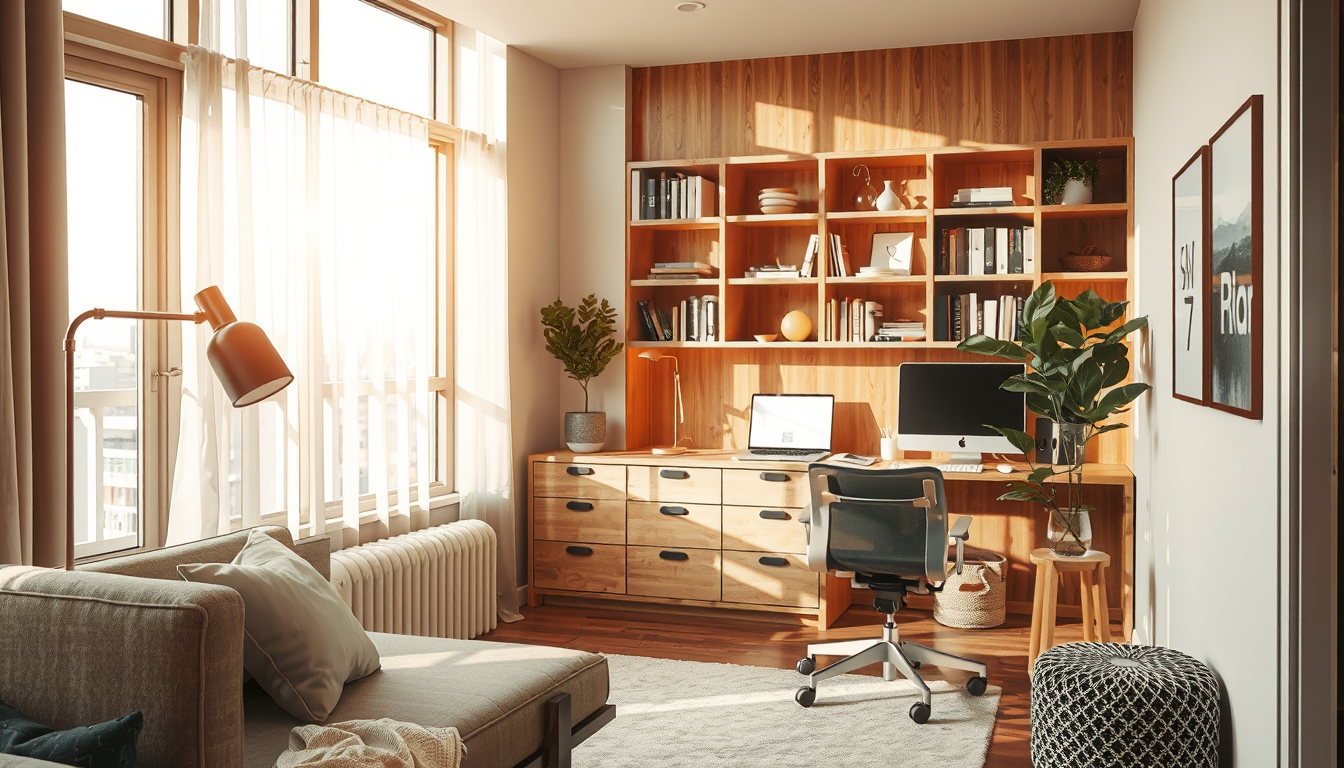
If you’re searching for home office bookshelf ideas canada homeowners actually use, start with one truth: your shelves need to work as hard as you do. With roughly 34 per cent of Canadian workers still hybrid or fully remote in 2026 , the home office has graduated from a makeshift desk in the corner to a room that deserves real design thinking. In Toronto especially — where the average condo hovers around 660 square feet — a bookshelf isn’t just storage. It’s your room divider, your Zoom backdrop, and your most visible piece of furniture. Here’s how to get it right.
Built-In vs. Freestanding Home Office Bookshelves for Canadian Spaces
The first decision shapes everything else. Built-ins deliver a seamless, wall-to-wall look that maximizes every vertical inch — critical when floor space is limited. In Toronto, custom built-in bookshelves typically run $3,000–$8,000 CAD installed, depending on linear footage, material, and finish complexity. For condo owners planning to stay long-term, that investment pays back in both function and resale appeal. A well-executed built-in also eliminates the awkward gap between shelf top and ceiling that collects dust and wastes visual height.
Freestanding shelves, on the other hand, offer flexibility. If you’re renting or expect to move within a few years, modular systems from Canadian retailers like EQ3 or Casalife let you reconfigure as your needs change. A single tall bookcase (72–84 inches) beside your desk provides roughly the same storage as a shallow closet, without any contractor lead times.
The hybrid approach is worth considering too: install a single built-in wall unit on your primary office wall, then supplement with a freestanding piece on the opposite side. This gives you architectural impact where your camera sees it and portability where you need it. For more ideas on making tight layouts work, see our guide to small bedroom solutions for Canadian condos — many of the same vertical strategies apply.
7 Bookshelf Layouts That Maximize Storage in Small Canadian Home Offices
Shop Compact Work-From-Home Staples
Desks, task lamps, and shelving do more for a condo office than oversized furniture that eats the room.
Toronto Interior Designer may earn a commission if you shop through these links at no extra cost to you.
Not every shelf arrangement suits every room. Here are seven layouts ranked by the space they work best in, along with realistic budget ranges:
| Layout | Best Room Size | Storage Capacity | Budget Range (CAD) | Key Advantage |
|---|---|---|---|---|
| Floor-to-ceiling built-in wall | 80–120 sq ft | Very high | $4,000–$8,000 | Maximum vertical use |
| Floating shelves above desk | Any size | Low–medium | $200–$600 | Keeps floor clear |
| L-shaped corner unit | 60–90 sq ft | High | $1,200–$3,500 | Uses dead corner space |
| Ladder shelf | Under 60 sq ft | Low | $150–$400 | Light visual footprint |
| Kallax-style grid (modular) | 70–100 sq ft | Medium–high | $300–$900 | Doubles as room divider |
| Asymmetric staggered boxes | Any size | Medium | $500–$1,500 | Architectural interest |
| Window-flanking twin towers | 80+ sq ft with window | High | $2,500–$5,000 | Frames natural light |
The window-flanking layout is a Toronto Interior Designer favourite for north-facing condo offices: two narrow floor-to-ceiling units on either side of the window create a library feel without blocking the light you desperately need through a Canadian winter. Pair them with a simple floating shelf bridging the top for a built-in arch effect that costs a fraction of a full millwork install.
“A bookshelf should solve at least two problems at once. If it only holds books, it’s not earning its square footage — especially in a Toronto condo.”
Home Office Bookshelf Styling: The 60/30/10 Designer Formula
The common mistake is treating a bookshelf as either pure storage or pure display. The approach we recommend at Toronto Interior Designer follows a 60/30/10 rule:
- 60% functional storage — books, binders, reference materials, and office supplies in baskets or boxes. Group spines by height rather than colour for a cleaner visual line.
- 30% curated display — a few art objects, a trailing pothos or snake plant, framed photos, or a small accent lamp to break up the grid. Vary the height and texture of these pieces so the eye moves naturally across the shelf.
- 10% breathing room — intentional empty space that keeps the whole arrangement from looking cluttered. This negative space is what separates a styled shelf from an overstuffed one.
For the back panels, 2026’s warm colour trends offer a low-commitment way to add personality. Deep greens, warm terracottas, and saturated navy tones are showing up across trend forecasts this year . Paint or wallpaper the shelf backing for a pop of colour you can change in an afternoon — no commitment required. If your office walls are already a warm neutral, our roundup of the best warm neutral paint colours for Canadian homes can help you pick a complementary shelf-back shade.
The “Neo Deco” influence identified in 2026 trend reporting translates well to shelf styling too . Think arched frame details, fluted trim pieces, and brass or unlacquered-brass bookends. These details elevate a basic rectangle into something with genuine character.
Best Canadian Retailers for Home Office Bookshelves in 2026
You don’t need to import from the US to get quality shelving. Here’s a sourcing checklist for Canadian buyers:
- EQ3 (Winnipeg-based, ships nationally) — clean-lined modular shelving in walnut and oak veneer, mid-range pricing.
- Bensen (Vancouver-designed, Canadian-made options) — minimalist solid-wood pieces for a Scandinavian-influenced look.
- Casalife (Toronto showroom on King West) — Italian-designed, budget-friendly wall units with good condo-scale options.
- Local millwork shops — Toronto’s Junction neighbourhood and the Etobicoke corridor have several custom cabinet makers who build bookshelves to spec. Expect four-to-eight-week lead times and the ability to match exact dimensions around your condo’s HVAC bulkheads and sprinkler heads.
- IKEA Billy/Oxberg system — still the best sub-$500 option; add custom trim and painted backs to make it look built-in.
- Crate & Barrel Canada / CB2 — solid mid-range options with regular sales; the Knox bookcase line fits narrow condo walls.
Buying Canadian-made cuts shipping costs and avoids cross-border duty headaches — and local millwork shops can do a site visit to measure, something off-the-shelf units simply can’t account for.
Bookshelf Materials That Handle Canada’s Humidity Swings
This is the section most US-focused design publications skip entirely. Canadian homes experience dramatic humidity shifts — dry winters with indoor relative humidity dropping below 25%, then humid summers pushing past 60%. That swing causes wood to expand and contract by 1–3% across seasons, which means gaps, warping, or cracked joints if you choose the wrong material.
- Solid hardwood (walnut, maple, oak) is beautiful but needs a humidifier in winter and careful finishing. Best for climate-controlled houses with consistent HVAC.
- Plywood-core with hardwood veneer is the most stable option for Toronto condos. The cross-grain lamination resists seasonal movement, and quality veneer looks identical to solid wood.
- Engineered wood / MDF handles humidity well and takes paint beautifully, but avoid it for heavy-load shelves unless the spans are short (under 30 inches) or reinforced with a metal bracket underneath.
- Metal framing with wood shelves sidesteps the problem entirely — the structure stays rigid while only the shelf surfaces flex minimally.
If you’re investing in built-ins, ask your millworker about plywood-core construction with a solid-wood face frame. It’s the standard in high-end Toronto cabinetry for exactly this reason. For broader renovation guidance, browse our renovation tips archive.
What to Do Next
Finding the right home office bookshelf ideas canada homeowners can actually execute comes down to matching your space, budget, and climate reality. Here’s your action checklist:
- Measure your office wall — height to the ceiling, width available, and depth you can afford to lose (12 inches is standard; 8 inches works for paperbacks and display).
- Decide built-in vs. freestanding based on your ownership timeline and budget.
- Pick your material with Canadian humidity in mind — plywood-core is the safest default.
- Apply the 60/30/10 styling rule so your shelves look intentional, not chaotic.
- Get three quotes from local makers if going custom — prices vary significantly across Toronto shops.
- Paint your shelf backs in a warm, saturated tone to add depth without a full room repaint.
Your bookshelf is the hardest-working surface in your home office. Give it the design attention it deserves, and it’ll pay you back every workday.
Make the Setup Feel Finished
Upgrade your office corner with better lighting, smarter storage, and one or two elevated pieces that keep it from feeling temporary.
Toronto Interior Designer may earn a commission if you shop through these links at no extra cost to you.
Sources
- Statistics Canada Labour Force Survey — https://www.statcan.gc.ca/
- Urbanation — https://www.urbanation.ca/
- House & Home 2026 Decorating Trends — https://houseandhome.com/
- Architectural Digest 2026 Trends — https://www.architecturaldigest.com/
Frequently Asked Questions
How much do built-in bookshelves cost in Canada?
Custom built-in bookshelves in Toronto typically cost $3,000–$8,000 CAD installed, depending on linear footage, materials, and finish complexity. Budget alternatives like the IKEA Billy system with custom trim can achieve a built-in look for under $500.
What is the best bookshelf material for Canadian homes?
Plywood-core with hardwood veneer is the most stable choice for Canadian homes. It resists the seasonal humidity swings — from below 25% in winter to over 60% in summer — that cause solid wood to warp, gap, or crack over time.
How do I style a home office bookshelf without it looking cluttered?
Follow the 60/30/10 rule: dedicate 60% of shelf space to functional storage, 30% to curated display items like art or plants, and leave 10% as intentional empty space. This balance keeps shelves looking purposeful and polished.