
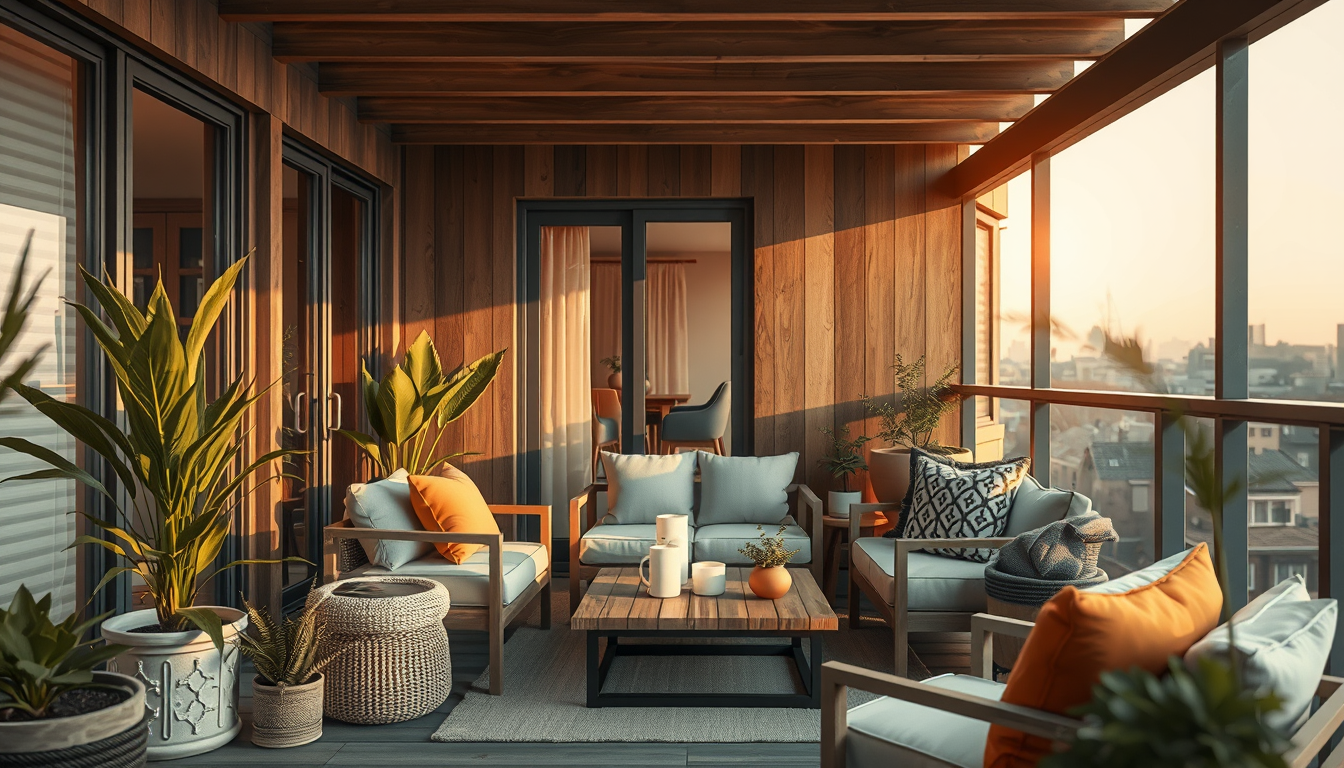
rosedale windy condo balcony design should start with two low-profile chairs, two weighted planters and a clear 760 mm circulation route—not a decorative shopping list. For a refined three-season setup, budget CAD $1,900–$6,500 before HST, based on March 2026 Canadian retail listings (IKEA Canada; CB2 Canada; Home Depot Canada; Canadian Tire; Veradek).
Last updated: April 1, 2026
Meta description: Create a Rosedale windy condo balcony design with Toronto-ready furniture, plants, heating, condo-rule checks and 2026 Canadian costs.
1. How Should a Rosedale Windy Condo Balcony Design Begin?
Begin with a wind audit. Record where gusts accelerate, rain collects and direct sunlight lasts at least 4 hours, since tower corners and gaps between buildings can create localized wind acceleration (City of Toronto Tall Building Design Guidelines).
Observe the balcony on 3 separate days, including one windy day. Place surveyor’s ribbon on temporary freestanding objects—never on the guard—to reveal airflow at chair and planter height. Glass guards may reduce wind near the floor while redirecting it over the guard or around open edges (National Research Council Canada).
We reviewed guidance from the City of Toronto, the Condo Authority of Ontario and Canadian safety agencies before developing this layout. The clearest takeaway is that nothing should be fastened to a balcony guard, slab or exterior wall without written condo approval (Condo Authority of Ontario).
Treat wind as a design measurement: keep weight low, preserve circulation and give every loose object an indoor storage plan.
2. What Should the Initial Balcony Budget Include?
Shop Balcony and Patio Pieces That Fit
Toronto outdoor spaces are often tight, so look for stackable seating, slim tables, and weather-ready textiles first.
Toronto Interior Designer may earn a commission if you shop through these links at no extra cost to you.
A practical mid-range budget is approximately CAD $3,800 before HST, delivery and assembly. The following allowances reflect March 2026 listings from IKEA Canada, CB2 Canada, Home Depot Canada, Canadian Tire and Veradek.
| Component | Planning allowance | Wind-conscious specification |
|---|---|---|
| Two lounge chairs | CAD $500–$1,800 | Low backs, broad feet and minimal loose upholstery |
| Compact table | CAD $150–$700 | Four-leg or pedestal base weighing about 14 kg or more |
| Two planters | CAD $360–$1,000 | Approximately 46–61 cm wide, drainable and weighted |
| Removable deck tiles | CAD $350–$900 | For roughly 45–75 sq. ft.; approval required |
| Outdoor rug | CAD $120–$500 | Flatwoven polypropylene with secured edges |
| Electric radiant heater | CAD $200–$700 | Canadian-certified and condo-approved |
| Storage | CAD $130–$500 | Weather-resistant box or indoor storage |
| Lighting and accessories | CAD $90–$400 | Outdoor-rated, removable and shatter-resistant |
Compare options in our outdoor living coverage and buyer guides before ordering pieces that must fit through a condo elevator.
3. Which Furniture Works Best for a Windy Rosedale Condo Balcony?
Choose compact furniture with substantial frames, broad feet and low backs. Folding café chairs, tall bar stools and lightweight aluminum tables are less suitable for exposed elevations because high-rise wind can become stronger and more complex near tower corners (City of Toronto Tall Building Design Guidelines).
For a narrow balcony, two lounge chairs generally preserve more circulation than a deep sectional. Keep the path between the suite door and balcony drain unobstructed so the exit, drainage and guard can perform their intended functions (Ontario Building Code; Condo Authority of Ontario).
Powder-coated steel provides useful mass, while outdoor-rated solution-dyed acrylic or olefin is designed to handle moisture and ultraviolet exposure more effectively than indoor upholstery (Sunbrella; UL Solutions). Loose cushions should come inside when strong winds are forecast (Environment and Climate Change Canada). Our guide to outdoor cushion storage outlines 7 practical storage options.
4. Which Layout Is Most Practical for a Rosedale Balcony?
Position two chairs facing inward, with the view visible beside the seating rather than directly beyond it. On balconies overlooking Mount Pleasant Road or the Rosedale ravine system, this arrangement can improve privacy without blocking the outlook.
Use 760 mm as an editorial planning target for the clear walkway, then ask building management whether a different egress dimension applies (Ontario Building Code). Keep furniture away from the guard, particularly pieces that children could climb (Condo Authority of Ontario).
A table that slides partly beneath a chair creates more usable floor area when it is not needed. Charcoal, bronze and warm-grey frames also coordinate easily with the brick and limestone found throughout Rosedale, although the neighbourhood does not impose a required balcony palette.
Teak-toned accessories can add warmth without visual clutter. Use the principles in our guide to mixing wood tones to keep the indoor and outdoor schemes connected.
5. How Can You Add Safe Warmth to a Rosedale Condo Balcony?
Use removable textiles and targeted electric heat instead of plastic sheeting or a permanent enclosure. Exterior screens, fixed panels and attachments to common elements may require authorization under sections 97 and 98 of Ontario’s Condominium Act, 1998 (Government of Ontario).
A flatwoven polypropylene rug provides underfoot comfort and releases moisture more readily than thick indoor-style pile (Carpet and Rug Institute). Secure its edges only with a removable method approved by the condo corporation.
For April, May, September and October, consider a Canadian-certified electric infrared heater after receiving written approval. The Electrical Safety Authority recommends using approved electrical equipment according to its rating and manufacturer’s instructions (Electrical Safety Authority).
Propane cylinders, barbecues and open-flame heaters may be prohibited even when a product is otherwise legal (Ontario Fire Code; TSSA). The building’s declaration, bylaws and rules therefore need to be checked before purchase (Condo Authority of Ontario).
6. What Lighting Feels Polished Without Becoming Permanent?
Combine one rechargeable table lamp with one low, outdoor-rated lantern. Avoid attaching string lights to guards, masonry or the balcony ceiling unless the condo has approved both the fixing method and the exterior appearance (Condo Authority of Ontario).
Choose fixtures bearing a recognized Canadian certification mark, such as CSA, cUL or cETL (Electrical Safety Authority). Shatter-resistant shades are preferable in exposed settings, and rechargeable fixtures should be stored according to the battery manufacturer’s temperature instructions.
Light around 2,700 K creates a warm residential appearance similar to traditional incandescent lighting (Natural Resources Canada). Aim fixtures inward and use shielded shades to reduce glare entering neighbouring Rosedale suites.
The effect should also work from inside the condo. Our guide to finished-looking window treatments explains how drapery and shades can frame balcony doors without competing with the view.
7. Which Plants Survive Windy Toronto Condo Balconies?
Choose compact, flexible plants in broad, heavy containers. Toronto’s general frost-free period runs approximately from May into October, although elevation and high-rise exposure can create a colder microclimate than a sheltered garden at grade (Toronto Master Gardeners; Environment and Climate Change Canada).
Sedum, catmint, chives and compact ornamental grasses are practical seasonal candidates when their light, soil and drainage requirements are met (Toronto Master Gardeners). No perennial is guaranteed to overwinter successfully on an exposed balcony.
Use UV-resistant fibreglass, rotationally moulded polyethylene or another container specifically rated for Canadian winters. Repeated freeze-thaw cycles can damage porous pots that remain saturated (CSA Group).
Drainage holes must remain open, but water and soil should not spill onto balconies below (Condo Authority of Ontario). Check moisture manually because humid summer periods may slow drying, while exposed autumn winds can dehydrate small containers quickly (Environment and Climate Change Canada).
8. How Should Planters Be Positioned and Secured?
Use freestanding planters with a low centre of gravity rather than railing boxes. A width of approximately 46–61 cm is a practical starting point, but management should confirm permitted balcony loads before soil, ballast or water reservoirs are added (Ontario Building Code; condominium corporation documents).
Do not drill into the slab, guard or exterior wall. Many Ontario balconies are exclusive-use common elements, so residents can use them privately without automatically having authority to alter them (Condominium Act, 1998; Condo Authority of Ontario).
Group two planters on the sheltered side of the seating area while leaving drains and maintenance access visible. Never place a container on the guard ledge (Condo Authority of Ontario).
If added weight is permitted, place ballast at the bottom and keep taller planting compact. This lowers the centre of gravity and reduces the amount of foliage exposed to gusts (National Research Council Canada).
9. Can Removable Deck Tiles Be Used Safely?
Removable deck tiles can work when the condo approves them and the installation preserves drainage, guard height and maintenance access. Structural work and alterations to guards may require a City of Toronto building permit, while a genuinely removable surface normally does not constitute structural construction (City of Toronto Building Permit Guide).
Confirm the permitted material because some corporations restrict combustible finishes or changes visible from outside the building (Condo Authority of Ontario). The tiles must not trap water around the slab, door threshold or drain.
Measure the finished floor level before ordering. Raising the walking surface can reduce the effective height of the existing guard, which must continue to satisfy applicable Ontario Building Code requirements (Ontario Building Code).
For approximately 45–75 sq. ft., allow CAD $350–$900 before HST and installation, based on March 2026 Canadian retail listings (IKEA Canada; Home Depot Canada).
10. Which Condo Rules Apply to Rosedale Balcony Designs?
Request written rules covering flooring, screens, planters, heaters, barbecues, lighting, contractor access and elevator bookings. Condo declarations, bylaws and rules are corporation-specific, and balconies are commonly designated exclusive-use common elements (Condo Authority of Ontario).
Ask whether the project requires board approval, an alteration agreement or contractor insurance. Removable furniture usually is not construction, but guard alterations, structural work and enclosures may require a City of Toronto building permit (City of Toronto Building Permit Guide).
Toronto fence permissions do not override condo rules. Municipal Code Chapter 447 generally allows residential fences up to 1.2 metres in front yards and 2 metres in other yards, subject to exceptions, but those limits do not grant permission for balcony screening (City of Toronto).
Tree-protection and grading rules become relevant only when the project extends to a terrace, townhouse yard or shared landscape (City of Toronto Urban Forestry; Toronto Water).
11. What Is the Best Overall Balcony Scheme?
The strongest three-season scheme combines two low-profile steel chairs, two weighted fibreglass planters, a flatwoven rug, compact lighting and condo-approved electric heat. Reserve at least CAD $300 for storage, covers and delivery, based on March 2026 Canadian retail prices.
A sectional is better suited to a deep, sheltered terrace. Folding furniture is practical only when every piece can be moved indoors after use or before severe weather (Environment and Climate Change Canada).
For most owners, stability, written approval and seasonal storage should come before colour or decoration. Buying fewer, heavier pieces also leaves more room for circulation and makes the balcony easier to clear for maintenance.
For broader planning ideas, browse our coverage of Toronto design trends and renovation planning.
12. What Seasonal Maintenance Does a Toronto Balcony Need?
Follow a simple seasonal schedule:
- March–April: Obtain current condo rules and inspect the drain, guard clearance and flooring condition (Condo Authority of Ontario).
- May: Move frost-sensitive plants outside after local frost risk has passed (Toronto Master Gardeners).
- June–August: Check soil moisture, rug edges and furniture stability weekly; move loose objects inside before strong winds (Environment and Climate Change Canada).
- September: Clean the approved heater and prepare indoor cushion storage (Electrical Safety Authority).
- October: Bring tender plants and rechargeable lights indoors before freezing nights become frequent (Toronto Master Gardeners).
- November: Remove loose textiles and water-retaining accessories while keeping the drain open (Condo Authority of Ontario).
- Year-round: Do not fasten furniture, planters or screens to guards without written permission (Condo Authority of Ontario).
Sources
- City of Toronto, Tall Building Design Guidelines, Building Permit Guide and Municipal Code Chapter 447.
- Condo Authority of Ontario, balcony safety and governing-document guidance.
- Government of Ontario, Condominium Act, 1998, Ontario Building Code and Ontario Fire Code.
- Environment and Climate Change Canada, Toronto climate data.
- Toronto Master Gardeners, frost-date and container-gardening guidance.
- National Research Council Canada, tall-building wind research.
- Electrical Safety Authority and TSSA, electrical, heater and propane guidance.
- CSA Group, product certification and freeze-thaw durability guidance.
- Natural Resources Canada, residential lighting guidance.
- IKEA Canada, CB2 Canada, Home Depot Canada, Canadian Tire and Veradek, March 2026 retail listings.
What Should Rosedale Condo Owners Know Before Designing a Balcony?
Can I install privacy screening on a Toronto condo balcony?
Yes, but only with written condo approval. A screen up to 2 metres may comply with some ground-level Toronto fence rules, but those rules do not override a corporation’s restrictions or authorize attachments to common elements (City of Toronto; Condominium Act, 1998).
How much should a three-season Rosedale balcony cost?
Budget CAD $1,900–$6,500 before HST for 2 seats, a table, planters, textiles, lighting, storage and optional electric heat. A balanced mid-range scheme costs about CAD $3,800 based on March 2026 Canadian retail listings (IKEA Canada; CB2 Canada; Home Depot Canada; Canadian Tire; Veradek).
Can I use a patio heater on a high-rise balcony?
Yes, but only if the condo approves the heater and power source in writing. A Canadian-certified electric infrared model typically costs CAD $200–$700, while propane and open-flame appliances may be prohibited (Electrical Safety Authority; TSSA; Ontario Fire Code).
When can balcony plants go outside in Toronto?
Move frost-sensitive plants outdoors during May after checking the local forecast. Toronto’s general frost-free growing period extends approximately from May into October, but an exposed high-rise balcony may be colder than grade-level gardens (Toronto Master Gardeners; Environment and Climate Change Canada).
Can I install deck tiles without a building permit?
Usually, provided the tiles are removable and do not alter the structure, drainage or guard. Condo approval may still be required, and the finished surface must not reduce the guard below its required Ontario Building Code height (City of Toronto Building Permit Guide; Condo Authority of Ontario).
Are barbecues permitted on Toronto condo balconies?
Only when the condo corporation permits the appliance and its fuel source. Obtain written approval before buying a barbecue or storing even 1 propane cylinder, because building rules and fire-safety restrictions vary (TSSA; Ontario Fire Code; Condo Authority of Ontario).
Toronto Interior Designer Editorial Team | Toronto-Focused Design Editors The Toronto Interior Designer editorial team researches practical interiors using Ontario regulations, Canadian product data and GTA-specific design constraints. Its coverage focuses on Toronto condos, houses and rental homes, with recommendations reviewed for local climate and building context. (/author/toronto-interior-designer-editorial-team/)
Layer the Outdoor Room
Lighting, planters, and textiles can stretch a short summer season and make even a small balcony feel intentional.
Toronto Interior Designer may earn a commission if you shop through these links at no extra cost to you.
Frequently Asked Questions
How much does a three-season Rosedale condo balcony cost?
Budget CAD $1,900–$6,500 before HST for seating, planters, textiles, lighting, storage and optional electric heat. A mid-range setup costs about CAD $3,800 based on March 2026 Canadian retail prices.
Can I install privacy screening on a Toronto condo balcony?
Only with written permission from the condo corporation. Screening attached to guards, walls or other common elements may require board approval under Ontario condominium rules.
Can I use a patio heater on a high-rise balcony?
Use one only after receiving written condo approval. A CSA-certified electric infrared heater typically costs CAD $200–$700, while propane and open-flame models may be prohibited.
Toronto Interior Designer is editorially independent. Our recommendations are based on research and editorial judgment, not brand sponsorships.