
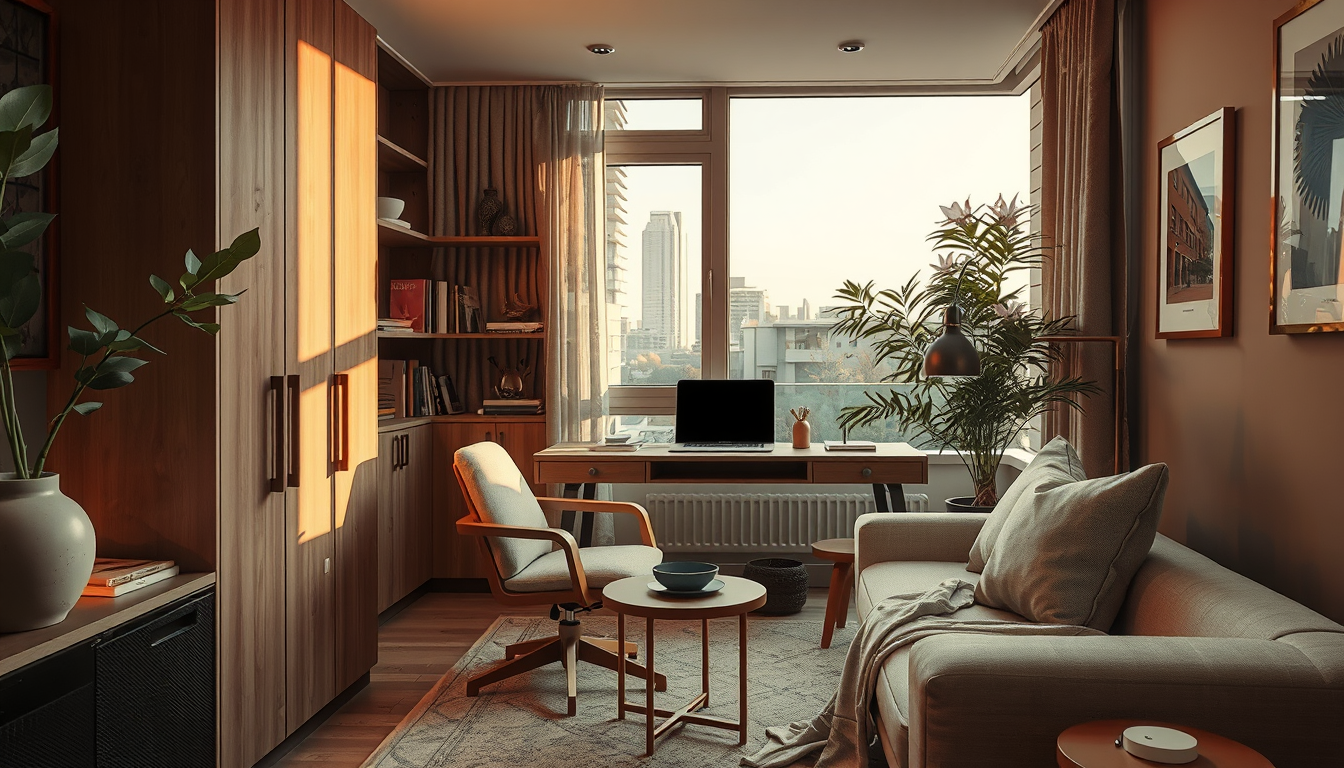
Your work from home setup canada 2026 needs to do more than hold a laptop and a coffee mug. With roughly one in four Canadian workers still logging hours from home at least part of the week , the makeshift pandemic desk is overdue for a proper redesign. The challenge is real: Toronto condos average 550–650 square feet, winter daylight disappears by 4:30 p.m., and the CRA expects a dedicated workspace if you want to claim your home office deduction. This guide covers ergonomic furniture, small-space layouts, winter-optimized lighting, and the tax-smart design choices that actually pay for themselves.
Why Your Work From Home Setup Canada 2026 Needs a Refresh
The home office conversation has shifted. In 2020, it was about survival — a folding table in the bedroom corner. In 2026, it is about performance, health, and longevity. Wellness-integrated design is the dominant editorial theme this year, with publications like Architectural Digest running multi-part series on how floor plans and materials affect long-term health .
For Canadian remote workers specifically, three forces converge that no other market faces in quite the same way:
- Compact real estate. A dedicated office room is a luxury most condo owners do not have. Multi-function furniture is not a nice-to-have — it is the only option.
- Limited winter light. Seasonal Affective Disorder affects an estimated 2–3% of Canadians severely, with another 15% experiencing milder winter blues . Your desk lamp is a health tool, not a decoration.
- Tax deduction requirements. The CRA’s detailed home office deduction method requires a workspace that is your principal place of work or used exclusively for earning income. Design decisions have direct financial consequences.
At Toronto Interior Designer, we see these constraints as creative opportunities, not compromises.
Best Ergonomic Furniture for Canadian Home Offices in 2026
Shop Compact Work-From-Home Staples
Desks, task lamps, and shelving do more for a condo office than oversized furniture that eats the room.
Toronto Interior Designer may earn a commission if you shop through these links at no extra cost to you.
Ergonomic chair and standing desk searches in Canada have climbed steadily since 2024, and Canadian retailers like Structube, EQ3, and IKEA Canada have expanded their home office lines in response . But ergonomic does not have to mean bulky. Here is what to prioritize:
| Element | Recommendation | Budget Range (CAD) | Works Best In |
|---|---|---|---|
| Desk | Sit-stand converter or compact electric desk (120 cm wide or less) | $250–$700 | Condos under 700 sq ft |
| Chair | Mesh-back ergonomic with lumbar support and adjustable arms | $400–$900 | Any dedicated workspace |
| Monitor arm | Clamp-mount arm to free up desk surface | $50–$150 | Small desks, shared surfaces |
| Footrest | Angled or rocking footrest for seated posture support | $40–$80 | Under any desk |
| Keyboard tray | Under-desk sliding tray to correct wrist angle | $60–$130 | Fixed-height desks |
“The best home office investment is not the most expensive piece — it is the one that corrects your worst postural habit. For most people, that is a proper chair and a monitor at eye level.”
If your workspace doubles as a dining area or living room corner, look at flexible and portable furniture options like the IKEA LANGDHOPP compact desk, designed specifically for the “office-in-a-corner” segment . Riffmade’s modular furniture line, built to move with you between rooms or apartments, is another strong option for renters who need a setup that adapts to changing layouts .
Small-Space Home Office Ideas for Toronto Condos Under 700 Sq Ft
In a 600-square-foot condo, every inch has a job. Here are five strategies Toronto Interior Designer recommends for carving out a functional workspace without sacrificing your living area:
- The closet conversion. Remove closet doors from a hall or bedroom closet, install a floating desktop at 29 inches, add a wall-mounted shelf above, and use the back wall for a pegboard organizer. Total footprint: under 10 square feet.
- The living room alcove. Position a narrow console desk (40–48 inches wide) behind a sofa or along a window wall. A desk this slim disappears visually when not in use. For window placement ideas that maximize natural light, we have a dedicated guide.
- The fold-down wall desk. Wall-mounted fold-down desks from brands like Prepac and South Shore give you a full work surface that stows flat against the wall. Pair with a wall-mounted monitor for a near-invisible office.
- The room divider setup. A bookshelf or curtain partition separates a work zone from a sleeping area in a studio. This visual boundary also strengthens your CRA deduction claim, since it helps establish a defined workspace.
- The mobile cart office. A rolling cart with a laptop riser, file storage, and power bar can serve as a complete portable office. Wheel it to the window for morning light, then tuck it beside the fridge after hours.
For more layout inspiration beyond the office, explore our home office category for ideas tailored to Canadian spaces.
Winter Lighting and Acoustics for Your Canadian Home Office
Canadian winters are the silent productivity killer in any home office conversation. Addressing light, sound, and temperature turns a tolerable workspace into one that sustains you through the darkest months. Here is how to fight back:
Lighting. Layer three types: ambient overhead light, focused task lighting at your desk, and a full-spectrum light therapy lamp positioned at arm’s length. A 10,000-lux SAD lamp used for 20–30 minutes each morning is clinically recommended and doubles as bright task lighting during dark January mornings . Position your desk perpendicular to the window rather than facing it to reduce screen glare while still catching sidelight.
Acoustics. Condo walls are thin. A wool area rug, upholstered chair, and even a textured throw blanket draped over a nearby chair absorb sound and reduce echo on video calls. If you are in a studio, a fabric room divider does double duty as both a visual partition and an acoustic buffer.
Temperature. Radiant desk heaters and heated foot mats keep your workspace comfortable without cranking the building thermostat. A small humidifier prevents the dry-skin, scratchy-throat fatigue that forced-air heating causes through Ontario winters.
CRA Home Office Tax Deductions: Smart Design Choices That Save Money
The CRA offers two methods for claiming home office expenses. The flat rate method allows eligible employees to claim $2 per day worked from home, up to $500 per year. The detailed method, which requires a T2200 form from your employer, lets you deduct a proportional share of rent, utilities, internet, and maintenance based on the square footage of your dedicated workspace .
Design choices that strengthen a detailed-method claim:
- Define your workspace physically. A room with a door is ideal, but a clearly partitioned area — bookshelf divider, permanent screen, or built-in nook — also qualifies.
- Measure and document. Calculate the percentage of your home’s total area that your office occupies. A 50-square-foot office in a 600-square-foot condo is 8.3% — that percentage applies to eligible expenses.
- Keep receipts for eligible expenses. Internet, electricity, rent, and minor repairs or maintenance to the workspace area are all deductible under the detailed method.
- Photograph your setup. In the event of an audit, dated photos of your dedicated workspace are strong supporting documentation.
The detailed method often yields well over $500 for condo renters paying Toronto-level rents, making it worth the extra paperwork.
What to Do Next
Your home office should work as hard as you do — ergonomically, financially, and through every grey February afternoon. Here is your action checklist:
- Audit your current setup. Sit at your desk and check: Is your monitor at eye level? Are your feet flat on the floor? Is your light source behind your screen causing glare?
- Measure your available space. Even 10 square feet can become a legitimate home office with the right furniture.
- Invest in lighting first. A full-spectrum SAD lamp and a quality task light deliver the highest return on comfort per dollar spent.
- Request your T2200 from your employer. Do this early in the tax year so you are ready to file.
- Choose one multi-function furniture piece. A sit-stand desk, a fold-down wall desk, or a rolling cart office — pick the format that fits your floor plan.
- Document everything. Measure your workspace, keep receipts, and take photos for your CRA file.
Toronto Interior Designer publishes practical, space-smart guides for Canadian homes every week. Start with the checklist above, and build a workspace that supports your health, your productivity, and your tax return.
Make the Setup Feel Finished
Upgrade your office corner with better lighting, smarter storage, and one or two elevated pieces that keep it from feeling temporary.
Toronto Interior Designer may earn a commission if you shop through these links at no extra cost to you.
Sources
- Statistics Canada Labour Force Survey — https://www150.statcan.gc.ca/n1/daily-quotidien/en/labour
- Architectural Digest Longevity Home series — https://www.architecturaldigest.com/
- Canadian Mental Health Association — https://cmha.ca/
- Google Trends Canada — https://trends.google.ca/
- Domino — https://www.domino.com/
- Design Milk — https://design-milk.com/
- UBC Mood Disorders Centre — https://www.ubc.ca/
- Canada Revenue Agency — https://www.canada.ca/en/revenue-agency.html
Frequently Asked Questions
What can I claim for my home office on Canadian taxes in 2026?
The CRA offers two methods: a flat rate of $2 per day up to $500, or the detailed method using a T2200 form to deduct a proportional share of rent, utilities, internet, and maintenance based on your workspace square footage.
How do I set up a home office in a small Toronto condo?
Use space-saving strategies like closet conversions, fold-down wall desks, living room alcove setups, or mobile cart offices. Even 10 square feet can become a functional work from home setup Canada 2026 with the right multi-function furniture.
What lighting do Canadian remote workers need in winter?
Layer ambient overhead light, focused task lighting, and a 10,000-lux full-spectrum SAD lamp used for 20–30 minutes each morning. Position your desk perpendicular to windows to reduce glare while catching natural sidelight.