
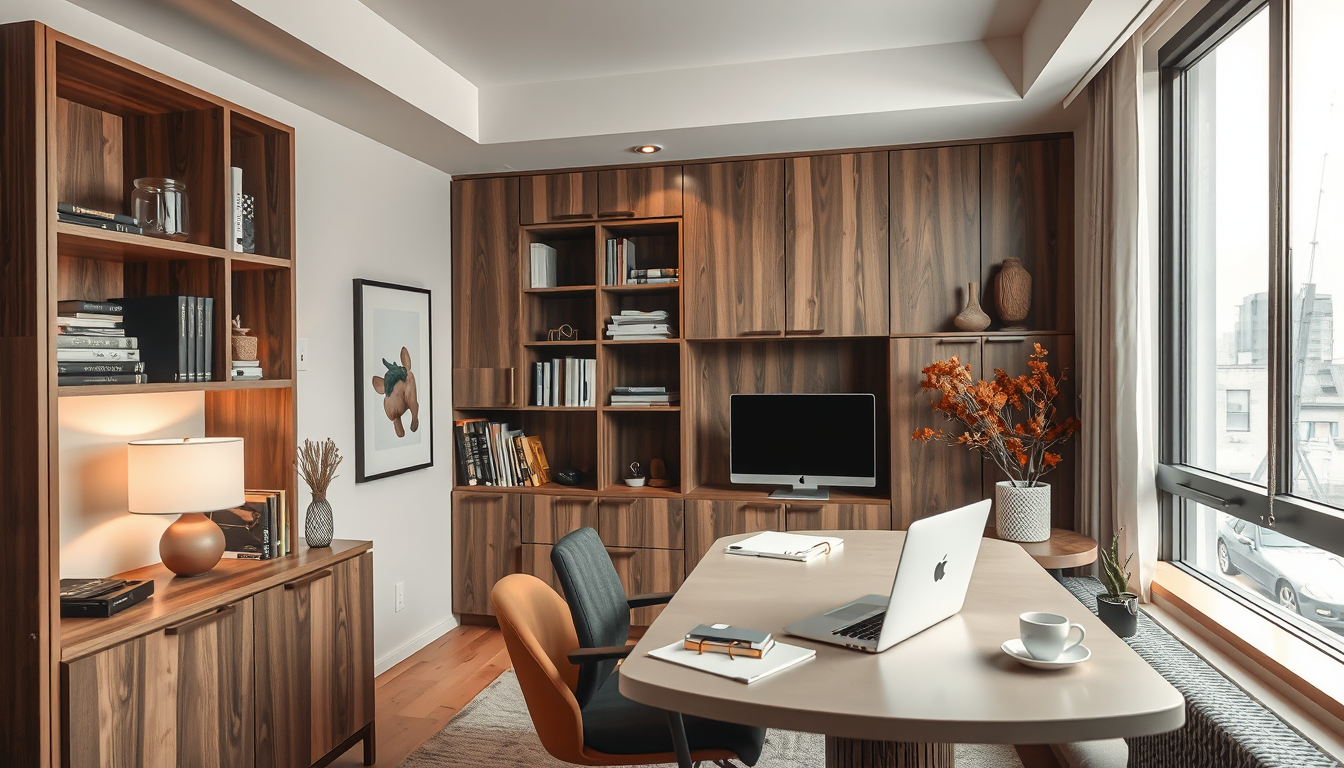
If you’re searching for built in home office ideas canada, you’re not alone — over 6.3 million Canadians now work from home at least part of the week, and the demand for permanent, functional workspaces has never been higher . The problem? Most online inspiration skips the part you actually need: what it costs in Canadian dollars, where to source materials locally, and how to make a built-in desk work in a 120-square-foot spare bedroom or a hallway nook. This guide delivers real CAD price ranges, local supplier options, and a tax angle most homeowners miss entirely.
Why Built-In Home Office Ideas Beat Freestanding Furniture in Canada
The shift is practical, not just aesthetic. A freestanding desk and bookcase eat roughly 25–30 square feet of usable floor space once you account for chair clearance and walking paths. A wall-mounted built-in with upper shelving reclaims most of that footprint while adding storage that reaches the ceiling — critical in Toronto condos where every square foot costs upward of $1,000 in purchase price.
Built-ins also solve the “hybrid chaos” problem. When your office doubles as a guest room or living space, a built-in with cabinet doors lets you close up shop at the end of the day. No visible clutter, no laptop perched on the dining table. That dual-purpose logic is why Domino’s 2026 analysis of Houzz renovation data found built-in storage is now the single most requested feature in home renovations, ahead of appliance upgrades .
At Toronto Interior Designer, we consistently see clients prioritize built-in work surfaces over standalone furniture — especially when the workspace needs to disappear into the room’s design after hours.
7 Built-In Home Office Layouts for Every Canadian Room Size
Shop Compact Work-From-Home Staples
Desks, task lamps, and shelving do more for a condo office than oversized furniture that eats the room.
Toronto Interior Designer may earn a commission if you shop through these links at no extra cost to you.
Not every home office needs a dedicated room. Here are seven configurations we recommend, matched to the spaces Canadian homeowners actually have:
- Wall-to-wall floating desk — A single slab counter (60–96 inches) mounted on French cleats with open shelving above. Best for spare bedrooms and basement offices.
- Closet conversion — Remove bifold doors from a standard 48-inch closet, add a desktop at 29 inches high, and install shelving to the ceiling. Ideal for condos under 700 square feet.
- Window-flanking bookcases with bridge desk — Two tall cabinets on either side of a window with a desk surface spanning between them. Maximizes natural light and creates a visually balanced focal wall.
- Under-stair niche — Custom-cut shelving and a pull-out keyboard tray fitted into the triangular space beneath a staircase. Common in Toronto’s two-storey semis.
- Kitchen peninsula extension — Extend the end of a peninsula or island by 24 inches with a lowered desk surface (typically 29 inches versus the standard 36-inch counter height). Works for quick-task stations in open-plan layouts.
- Hallway built-in — A 12-inch-deep floating shelf with a fold-down desk section in a wide hallway (minimum 42 inches clear width after installation to meet code).
- Murphy desk and bed combo — A vertical murphy bed with an integrated fold-down desk panel. The ultimate dual-use solution for studio apartments where floor space is non-negotiable.
“The best home office isn’t the biggest one — it’s the one that fits your actual work habits and disappears when you’re done. In Canadian homes, that almost always means building in, not buying more furniture.”
Built-In Home Office Costs in Canada: Custom vs. IKEA Hack Pricing
This is where most online guides fail Canadian readers. Here’s what you’ll actually pay in the GTA market as of 2026:
| Approach | Cost Range (CAD) | Lead Time | Best For | Key Trade-Off |
|---|---|---|---|---|
| Fully custom cabinetry | $800–$3,500/linear foot | 8–14 weeks | Odd-shaped spaces, premium finishes | Highest cost; requires skilled installer |
| Semi-custom (DERA, California Closets Canada) | $500–$2,000/linear foot | 4–8 weeks | Standard room sizes, good finish quality | Limited size/config options |
| IKEA BILLY/ALEX hack | $400–$700 total | 1–2 weekends (DIY) | Budget builds, renters, starter offices | Particleboard durability limits |
| Local millwork shop | $1,200–$2,800/linear foot | 6–10 weeks | Supporting local trades, mid-range budgets | Quality varies by shop |
Canadian lumber and plywood prices remain 15–25 percent above pre-2020 levels, which makes material selection a real budget lever . Choosing paint-grade MDF over walnut veneer plywood can cut material costs by 40–60 percent with minimal visual difference when the finish is well-executed. For a six-foot built-in desk with upper shelving, expect to spend roughly $2,500–$4,500 CAD at the semi-custom level or $5,000–$12,000 fully custom installed.
If you’ve tackled storage-focused renovations before, you already know that material choice drives the final number more than labour in most cases.
Canadian Suppliers and Materials for Built-In Home Offices
Skip the generic Pinterest supply lists. These are the sources Toronto Interior Designer readers consistently rely on for built-in office projects:
- Richelieu Hardware (richelieu.com) — Professional-grade soft-close slides, European cup hinges, and cable management grommets. Ships across Canada with contractor pricing tiers.
- Windsor Plywood — Locations in Ontario and Western Canada with a better plywood selection than big-box stores, including pre-finished maple and birch panels ideal for shelving.
- DERA Custom Cabinetry — Canadian semi-custom manufacturer with an online configurator that lets you spec exact dimensions. Ships flat-pack for local installer assembly.
- California Closets Canada — Offices across the GTA. Their home office line includes sit-stand desk inserts and integrated filing drawers.
- IKEA Canada — The BILLY (40 cm and 80 cm widths) paired with an ALEX drawer unit and a KARLBY countertop remains the most replicated budget built-in on Canadian design forums, typically landing between $400 and $700 all in.
For paint, stick with warm neutral tones on built-in cabinetry — they read as custom millwork and age better than trendy colours that date within two years.
How to Deduct Your Built-In Home Office on Canadian Taxes
Here’s the angle almost no design publication covers: if you work from home and your employer signs a T2200 form, your built-in home office may partially pay for itself at tax time.
The CRA offers two methods for home office deductions:
- Flat-rate method — Claim $2 per day worked from home, up to $500 per year. Simple, no receipts needed, but doesn’t capture capital costs.
- Detailed method (T2200) — Requires employer certification but lets you deduct a proportional share of home expenses including, potentially, capital cost allowance (CCA) on built-in furniture that is affixed to the home.
The detailed method is where built-ins become interesting. A $5,000 custom desk wall in a room that represents 15 percent of your home’s square footage could generate meaningful deductions over several tax years through CCA . Consult a Canadian tax professional before filing — the rules around “affixed” versus “movable” furniture matter, and getting the classification wrong can trigger reassessment.
What to Do Next
- Measure your space — Record wall width, ceiling height, and any obstructions (baseboards, vents, electrical outlets). A 10-minute measuring session prevents thousands in change orders.
- Set a hard budget in CAD — Use the table above to identify your tier: under $700 (IKEA hack), $2,500–$4,500 (semi-custom), or $5,000+ (full custom).
- Request three local quotes — Ask for installed price per linear foot, material specs, and lead time in writing.
- Check your T2200 eligibility — Ask your employer now, before you file, whether they’ll certify the form for the current tax year.
- Choose your material strategy — Paint-grade MDF for budget builds, birch plywood for durability, walnut veneer only if the budget supports it.
- Browse more home office inspiration — See how other Canadian homeowners have tackled the same challenge.
Built-in home office ideas for Canada don’t have to mean five-figure budgets or months of renovation disruption. Start with your measurements, pick the tier that matches your finances, and build something that actually works for how you live and work — through every Canadian season.
Make the Setup Feel Finished
Upgrade your office corner with better lighting, smarter storage, and one or two elevated pieces that keep it from feeling temporary.
Toronto Interior Designer may earn a commission if you shop through these links at no extra cost to you.
Sources
- Statistics Canada Labour Force Survey — https://www.statcan.gc.ca/en/subjects-start/labour_
- Domino / Houzz Kitchen Trends Report — https://www.domino.com/content/kitchen-trends-2026/
- CMHC Housing Market Data — https://www.cmhc-schl.gc.ca/
- CRA Home Office Expenses — https://www.canada.ca/en/revenue-agency/services/tax/individuals/topics/about-your-tax-return/tax-return/completing-a-tax-return/deductions-credits-expenses/line-22900-other-employment-expenses/work-space-home-expenses.html
Frequently Asked Questions
How much does a built-in home office cost in Canada?
Costs range from $400–$700 CAD for an IKEA hack, $2,500–$4,500 for semi-custom cabinetry, and $5,000–$12,000+ for fully custom installed built-ins. Material choice — such as paint-grade MDF versus walnut veneer — is the biggest cost driver.
Can I deduct a built-in home office on my Canadian taxes?
If your employer signs a T2200 form, you may deduct a proportional share of home expenses using the CRA’s detailed method, including capital cost allowance on built-in furniture affixed to your home. Consult a Canadian tax professional for eligibility.
What is the best built-in home office layout for a small Canadian condo?
A closet conversion or wall-to-wall floating desk works best in condos under 700 square feet. Both maximize vertical storage, keep the footprint minimal, and can be closed off to hide workspace clutter in multi-use rooms.